Written by Garima Tiwari


( http://www.glogster.com and http://www.gandhiforchildren.org)
The recent case of an Indian new-born baby allegedly sold for 800,000 rupees ($ 14,750) over Facebook, opened up many questions on the prevalence and working of child trafficking racket in the country. The boy, born in a hospital in Ludhiana in the northern state of Punjab, was sold twice before the deal on the social networking site. The infant’s grandfather allegedly first snatched the child from his own daughter, telling her he had been stillborn, to sell him to a nurse for 45,000 rupees. The nurse, in turn, reportedly sold the baby for 300,000 rupees to a hospital lab assistant. The infant was then allegedly put up for sale on Facebook by the lab assistant, and a businessman from New Delhi is accused of offering 800,000 rupees for him after seeing photographs. The police raided the businessman’s house and recovered the child. They also arrested five people including the grandfather and another man accused of facilitating the deals. Tens of thousands of children in India are thought to be trafficked every year, some for adoption but also many for bonded labour, begging or sexual exploitation.[i] That is hardly the experience of most parents. Since 2007, when the exposure of a serial killer in Nithari, on the outskirts of New Delhi, revealed that local police had ignored parents’ pleas that their children had disappeared, evidence has piled up showing that officials continue to disregard complaints of missing children.[ii]
Many, many such incidents are repeatedly reported with multitude of reasons for trafficking and sad implications. Take for example, Smita a sixteen year old girl was taken from her village in Jharkhand, India and subjected to various forms of sexual abuse and exploitation at the hand of her employers including rape. When rescued her parents refused to take her back since she had been tainted by rape. Falling sex ratios in Haryana and Punjab has led to a need for trafficking of brides from villages in Orissa, Jharkhand, Bihar, Assam and West Bengal, who have been sold off by the parents. Jyoti, age fourteen, was sold and married to a 40-year old man for Rs 15,000 in order to produce a mail heir[iii]
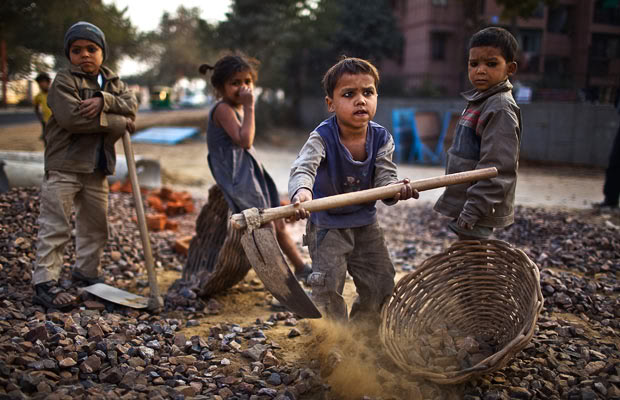
This post highlights the need for urgent action by the authorities to fight child trafficking in India. A huge number of children from a place called Tarai in Nepal are trafficked to India everyday and they fall victims to child labor. Approximately 90,000 children went missing in India in 2011 alone. Nearly half of these cases remain unsolved. Thus, while there is movement of children through procurement and sale from one country to another, with India being both a supplier as well as a “consumer”, there is internal “movement” of children within the country itself – one town to another, one district to another and one state to another. It is undertaken in an organised manner, by organised syndicates or by individuals, and sometimes informal groups. Relatives and parents are part of this as well.[iv] Children as young as 5 years are sold to traffickers by their parents who are in need of money and brought to India. These children are trafficked to various parts of India like Delhi, Mumbai and Kolkata and are made to work in cloth factories, have to stitch bags and perform various hazardous and odd jobs. [v] In 2012 about 250 Nepali children were rescued from the India-Nepal border. There are number of unregistered orphanages in Nepal which are trafficking children to different parts of the world and Indian human rights activists speculate that there are thousands of Nepali children who work in India. In March 2013, 38 tribal children, including 32 minors were rescued who were being taken by train for bonded labor. [vi]Their parents were given an advance amount of Rs 1,000 for a bonded labour of 40 days for the children, to work at the under construction site of railway tracks in Nagpur in India. The agents involved in trafficking usually give these minor girls the look of a married woman so that they are not easily caught. The boys were to be paid a daily wage of Rs 160 and girls Rs 150.
The chart below shows some of the methods of trafficking:

Chart taken from the Manual For Social Workers : Dealing with child victims of trafficking and commercial sex exploitation[vii]
The Indian Constitution under Article 23 specifically prohibits human trafficking, asserting that all citizens have the right to be protected from exploitation. Article 36 of the Convention on the Rights of the Child provides for protection of children from exploitation and physical and psychological recovery and article 39 of the CRC provides for the social reintegration of child victims of exploitation. In India, various laws like Juvenile Justice (Care and Protection) Act of 2000 (JJA), Immoral Traffic (Prevention) Act of 1956 (ITPA) amended in 1986, and the like, are providing support, care, and protection to these children in various State Homes across the country.
In June 2011, India ratified the United Nations Protocol to Prevent, Suppress and Punish Trafficking in Persons, Especially Women and Children, which supplemented the 2000 UN Convention Against Transnational Organised Crime. India’s response to the problem of trafficking has been considerably influenced by its Trafficking in Person (TIP )Report rankings. The definition of trafficking under the UN TIP Protocol is the “recruitment, transportation, transfer, harbouring or receipt of persons” by using “force[,] . . . coercion, abduction, fraud, [and] deception” to control and exploit another person, including, but not limited to, sex exploitation.Between 2001 and 2003, India figured in Tier Two of the TIP Report before being demoted to the Tier Two Watch List. It was only in May 2011 when India ratified the UN Protocol that it made its way once again into the Tier Two List. India’s response to the trafficking problem in terms of abolishing trafficking isn’t unique in the sub-continent. Indeed, the 2002 SAARC Convention on Preventing and Combating Trafficking in Women and Children defines trafficking as sex trafficking following a 1949 UN Convention, rather than the 2000 UN Protocol.[viii]
While India has ratified the UN Convention for the Suppression of the Trafficking in Persons, without reservation, and enacted ITPA in response showing its intention to fight trafficking, Section 7 of the said act which penalizes those who prostitute in or near public places, and Section 8, which penalizes the solicitation of sex, both of which have in practice justified the police’s arrest and imprisonment of trafficked women who have been forced into prostitution and who have no knowledge or control over the brothel’s proximity to public places. Amending the law to exclude Sections 7 and 8 would decriminalize the activities of trafficking victims who are forced to solicit for sex. In 2006, a bill to amend the ITPA was proposed by India’s Ministry of Women and Child Development, which would decriminalize prostitution and instead would penalize prostitutes’ clients. The law currently contains provisions that penalize brothel owners, managers, and traffickers. The Ministry of Home Affairs also set up specialized police units in major Indian cities in 2011 with the sole task of investigating sex trafficking cases and arresting traffickers and brothel owners and managers. These police officers were specially trained and sensitized to understand how trafficking rings operate. However, the police lack the resources to investigate and make arrests on every trafficking case. [ix] Even after arrest the judicial process is so slow that while one is being put under trial, the whole trafficking ring keeps flourishing.
The recent Criminal Law Amendment Act, 2013 recognises trafficking as an offence in the Section 370 of the Indian Penal Code . This is on the similar lines as the Palermo Protocol, also ratified by India in May 2011, following a Supreme Court judgement defining trafficking in a public interest litigation (PIL) field by Bachpan Bachao Andolan in 2011. The bill targets the entire process that leads to trafficking of a person and also makes the employment of a trafficked person and subsequent sexual exploitation a specific offence under Section 370 A.[x] While the old section 370 of Indian Penal Code dealt with only buying or disposing of any person as a slave the new section will take in its purview buying or disposing of any person for various kinds of exploitation including slavery. This provision includes organ trade as well. As the explanation further clarifies “exploitation” would also include prostitution. This is in addition to the ITP Act, 1956. The new section also ensures that persons involved at each and every stage of trafficking chain are brought within the criminal justice system.Also by specifically including that if a person is brought with his/her consent, where such consent is obtained through force, coercion, fraud, deception or under abuse of power, the same will amount to trafficking, the law has been substantially strengthened. This will cover all situations where girls who happen to be major are duped with promises of marriage and willingly accompany the traffickers who exploit them in various ways. While earlier no specific offence was made out for the mere bringing of the girl in question now that too is criminalized. It has also been specifically added in the provision that consent of the victim is immaterial for the determination of the offence.The new section also differentiates the instances of trafficking major persons from minor persons. This differentiation is brought about by providing separate penalty for each with higher minimum sentence for trafficking minor persons.In addition the section also provides for enhanced punishment for repeated offender as well as where the offender traffics more than one person at the same time. By providing that trafficking in minor persons on a repeated conviction will attract imprisonment for life (meaning the remaining natural life) the law has been substantially changed.[xi] This will surely act as a big deterrent. Involvement of a public servant including a police officer shall entitle him to life imprisonment which shall mean the remaining natural life.[xii] Addition of the section 370 A further adds strength to trafficking related law by criminalizing employment of a trafficked (major/minor) person. A person who has even reason to believe or apprehension that the minor/major person employed by them has been trafficked will make them criminally liable. This places a huge responsibility on the employers who were till now, let off easily under the not so strict provisions of the child labour laws and juvenile related laws. Here also a higher minimum prison term is prescribed where a minor person is involved. Also important is the fact that irrespective of age of the person employed, simply employing a trafficked person is an offence. This provision will go a long way in ensuring that people verify the antecedents of the placement agencies as also get the police verification of the persons employed. This will also aide in curbing the huge demand for labour who are victims of unsafe migration.[xiii]
The enactment of the law on paper with no real training and support to the functionaries would be futile and therefore, what is needed now is “actual”, “planned” and “effective” implementation. Involving the community participation in the whole implementation process would create a greater impact. The procedures and technicalities should not reduce the ambitious legislations to empty words, because at stake here are the children- the future of the nation.
(For those who want to get a deeper understand of the brutality of the child trafficking rackets I recommend the movie recently screened at the Cannes Film Festival on May 22 titled: “Oass- The Dew Drop”, which is inspired by a real-life story of abduction of an 11-year-old Nepalese girl who is sold to a brothel in Delhi by her aunt. (http://www.youtube.com/user/OassTheFilm))

 “Wars between states are confined to geographical areas and have a declared set of combatants, but terrorism can be conducted with relative ease across many national borders.”