Witness Protection and the ICT in Bangladesh

Written by: Umme Wara, Lecturer of Law, Jagannath University

The free and truthful participation of witnesses to testify before the Court largely depends on the protective and security measures provided by the concerned Court in any crimes Tribunals as witnesses always have some reasonable fear to be suffered furtherance by the defense party. Since 2010, when Bangladesh started the trial of war criminals the security issue of those who testify became an imperative issue to be determined through relevant national instruments and international experiences. In this regard we will look in to the measures for witness and victim protection in other international and hybrid tribunals as well as the International Crimes (Tribunals) Act (ICT), 1973 which can be referred to the proposed law on victim and witness protection as further edition.

The witness and victim protection and support provisions of international and hybrid criminal tribunals: The Statutes of the Extraordinary Chambers in the Courts of Cambodia (ECCC), the International Criminal Court (ICC), the International Criminal Tribunal for Rwanda (ICTR), the International Tribunal for the former Yugoslavia (ICTY), the Special Court for Sierra Leone (SCSL), and the Special Tribunal for Lebanon (STL) inserted provisions for victims and witness protection where the Rules of Procedure and Evidence provided policies to implement those provisions of the statutes effectively. For example, Article 68 of the Rome Statute on the International Criminal Court provides that “the Chambers of the Court may, to protect victims and witnesses or an accused, conduct any part of the proceedings in camera or allow the presentation of evidence by electronic or other special means,” noting that these measures should be implemented in particular in the case of a victim of sexual violence. This statutory provision regarding in camera proceedings is implemented through specific sections of Rules 72, 87, and 88 of the Rules of Procedure and Evidence.

Among other functions, these rules define the appropriate use of in camera proceedings consistent with the statute. They also lay out the in camera procedure to consider relevance or admissibility of evidence related to consent in alleged crimes of sexual violence and the specific procedures, including notice requirements, for requesting in camera proceedings and other available measures.

Provisions guaranteeing the victim and witness protection and applying explicit language conditioning these protective measures on the accused’s right to a fair trial are common to all statutes. For example, the statutory language may specify that the measures cannot be prejudicial or that they must not be inconsistent with the rights of the accused.

Summary of approaches to victim and witness protection in different statutes and Rules of Procedure and Evidence:

In order to properly understand the protections that the ICT affords to witnesses, it is important to look at the approaches taken by the other existing international criminal tribunals.

ECCC approach: is a very broad directive that proceedings shall respect the rights of victims and the accused and that the Court shall take measures to protect victims and witnesses. (See specifically Article 33, and Rules 12, 24, 25, 29, and 60).

ICTY and ICTR approach: has a directive that proceedings shall respect the rights of victims and the accused and that the Court shall take measures to protect victims and witnesses. It also contains an explicit provision that victim and witness protection measures shall be incorporated in the Rules of Procedure and Evidence adopted by the judges. (See specifically Articles 14, 19, and in particular Article 21 of the ICTR statute, Articles 15, 20, and in particular Article 22 of the ICTY statute and Rules 34, 53, 69, 70, 75, 77 and 79,ICTR and ICTY )

SCSL approach: the rights of accused to a fair and public hearing are subject to witness protection measures. It also provides for establishment of Victim and Witness Unit offering protective services. It specifies that consideration should be given to employment of prosecutors and investigators experienced in gender-related crimes. (See specifically Articles 15, 16, and 17 of the statute, and Rules 34, 69, 70, 75, and 79)

STL approach:  the rights of accused to fair and public hearing subject to witness protection measures. It provides for establishment of Victim and Witness Unit offering protective services and for participation of victims in proceedings. It provides for access to victim compensation. There is an explicit provision that victim participation and victim and witness protection measures shall be incorporated in the Rules of Procedure and Evidence adopted by the judges. (See specifically Articles 12, 16, 17, 25, and 28 of the statute and Rules 50, 51, 52, 93, 116, 133, 137, 139, 159, and 166).

ICC approach: Comprehensive statutory provisions establishing Victim and Witness Unit and specifying victim and witness protection obligations of Prosecutor, pre-trial chamber, and trial chamber provide protective measures, particularly in cases of sexual violence. Also includes provisions on victim participation, reparations, a victim trust fund, and specific provisions for the protection of victims involved in requests for assistance. (See specifically Articles 43, 53, 54, 57, 64, 75, 79, 87, and in particular Article 68 of the statute and Rules 16, 17, 18, 19, 43, 72, 76, 81, 87, 88, and 112)

ICT: Though the 1973 Act does not contain any provision regarding witness and victim protection, the Rules of procedure has been amended in June 2011 where the term “Victim” has been defined (Sub Rule 26 in Rule 02) as a person who has suffered harm as a result of commission of the crimes under section 3(2) of the International Crimes (Tribunals) Act, 1973.” Besides, under the new Chapter VIA, a new Rule 58 A(1) has been inserted on Witness and Victim Protection which says “[t]he Tribunal on its own initiative, or on the application of either party, may pass necessary order directing the concerned authorities of the government to ensure protection, privacy and well-being of the witnesses and or victims. This process will be confidential and the other side will not be notified”. Sub Rule 02 inserted arrangements of accommodation of witnesses or victims and other necessary measures regarding camera trial and keeping confidentiality as necessary where violation of such undertaking shall be prosecuted under section 11(4) of the Act.

The success of these protective measures is yet to be proved especially with regard to the sexual violence witnesses. Besides holding the camera trial, the Tribunal should take other protective measures so that the witnesses come forward more to testify before the Tribunal.

Lastly, the proposed national law on victim and witness protection addresses many significant needs of members of this vulnerable group, and acknowledges the importance of support mechanisms that address physical, psychological, and economic wellbeing of victims and witnesses who will testify before the Court. However, the proposed legislation does not provide comprehensive measures compared to those provided by international and hybrid criminal tribunals. So if we want to ensure the safety and security for witnesses of any crime in future, we need to take certain guidelines from the international and hybrid tribunals which are consistent and feasible to the present socio-economic context of Bangladesh.

Domestic War Crimes Tribunal in the International Context: Bangladesh

Written by: Iffat Rahman [1]

Here in Dacca we are mute and horrified witnesses to a reign of terror by the Pak Military. Evidence continues to mount that MLA authorities have a list of Awami League supporters whom they are systematic and shooting them down.[i]

The Second World War has significantly shaped the human rights field and it has led to many Conventions and international laws and furthered the establishment of the rule of law for war crimes and prosecuting war criminals. Furthermore, to prevent and punish future crimes against humanity, in the shadow of the Holocaust, on 9 December 1948, the United Nations passed the Convention on the Prevention and Punishment of Genocide, which came into effect in 1951. One year later, Pakistan signed the treaty on Convention on the Prevention and Punishment of Genocide on 11 December 1948 and ratified it on 12 October 1957. However, even the treaty did not prevent the Pakistani Army from committing one of the worst genocides in 1971 when Bangladesh was separated.  Justice was never served for the victims until recently when the government of Bangladesh established the International Crimes Tribunals (ICT) where they are prosecuting people who collaborated with the Pakistani Army in 1971.

Recently, the ICT in Bangladesh has created a division within country in half and it had been reported that more than 80 people were killed in clashes over the Tribunal’s verdict and chaos followed. Many Hindu houses were burned down. The international justice community has been quick to point out that the current party in power, Awami League, and the current leadership of Sheikh Hasina, Prime Minister of Bangladesh, is after revenge rather than justice. Modeled after the Nuremberg trials, the tribunal, which has commenced in 2010, repeatedly faced criticism from the international community about the fairness and the openness of the trials. So far, the ICT has indicted 11 people for collaborating with the Pakistani Army and most of them hold high positions within the two opposition parties, Jamaat-e-Islami and Bangladeshi Nationalist Party. Abul Kalam Azad, member of Jamaat-e-Islami, was sentenced to death in absentia and the ICT gained quite a bit of attention after Mr. Abdul Quader Molla, senior leader of Jamaat-e-Islami, whose previous sentence of life imprisonment was overturned and received death penalty after a popular protest. Delwar Hossain Sayeedi, leader of the Jaamaat-e-Islam, was sentenced to death.

Is it genocide?

Along with the genocide in Rwanda, the Holocaust in Germany, the Bangladeshi atrocity was one of the worst atrocities committed in the 2Oth century. However, unlike the other genocides, the Bangladeshi genocide is one of the least studied genocides in the modern day history.  Bangladesh suffered a violent birth and whether or not, the war between East Pakistan and West Pakistan was genocide has been debated among the scholars many times. The war created 10 million refugees. According to the Convention on the Prevention of and Punishment, genocide is:

Article 2

In the present Convention, genocide means any of the following acts committed with intent to destroy, in whole or in part, a national, ethnical, racial or religious group, as such:

  • (a)      Killing members of the group;
  • (b)      Causing serious bodily or mental harm to members of the group;
  • (c)      Deliberately inflicting on the group conditions of life calculated to      bring about its physical destruction in whole or in part;
  • (d)      Imposing measures intended to prevent births within the group;
  • (e)      Forcibly transferring children of the group to another group.[2]


The massacre that happened in Bangladesh clearly fits within the realm of the definition of genocide. At that time, press rarely called it genocide but it is without a doubt that the Pakistani Army targeted Hindus selectively. The Hindu Bengalis became the Jews of Germany for the Pakistani Army. They were hunted down, killed, and the Pakistani Army unleashed a massacre that took place on defenseless villagers, peasants, students, mothers, and children.  According to confessions by Pakistani army soldiers and officers, they were ordered to kill Hindus, Kafirs (non-Muslims) and to show no mercy. Bengalis were seen as an inferior race. Lastly, India spoke out against the genocide, condemning and calling it,  “savage and medieval butchery” and “preplanned carnage and systematic genocide.”[ii] Telegrams were sent from the American Embassy to Washington labeling the massacre as “selective genocide”.  Bengali Army officers within the Pakistani Army were disarmed and executed. The massacre happened under a control command system and it was well planned by the West Pakistani Army. According to, A. Dirk Moses,

Yahya Khan, the Pakistani President, was “pushing through its own ‘final solution’ of the East Bengal problem.” Officers he interviewed told him that they were “determined to cleanse East Pakistan once and for all of the threat of secession, even if it means killing off two million people and ruling the province as a colony for 30 years.” “Pogroms” were instituted against recalcitrant villages in “kill and burn” missions. Entire “villages [were] devastated by ‘punitive action’,” which authorities called a “cleansing process.” Hindus were targeted for “annihilation,” because they were thought to be a minority of unscrupulous merchants who dominated the economy and siphoned off wealth to India.[iii]

When a massacre happens at a level where millions of people were killed because of there is a difference in religion, ethnicity and race, then it is a clear case of genocide.


A Brief History

There were many events led up to the genocide in Bangladesh. It is impossible to separate Bangladesh’s history from the partition of India. The partition also separated Bengal province of British into East Bengal and later on to East Pakistan and the West Bengal.  In 1948, Bengali movement starts where 54% of the population in Pakistan spoke Bengali and minority of the population spoke Urdu in West Pakistan where population also spoke Punjabi, Baluchi, Pashtun and Sindhi. Before that year, in 1947, a resolution advocated for Urdu to be the sole language of Pakistan, which caused Bengalis to protest, and later transformed into a movement. In 1949, the All Pakistani Awami Muslim League was formed and later changed into All Pakistani Awami League. In 1955, Sheikh Mujibur Rahman, then elected General Secretary, was re-elected as the leader of the Party and name of the Party changed completely to Awami League. Pakistan became an Islamic Republic and Bengali became a state language along with Urdu. In 1956, Awami League leaders demanded for provincial autonomy in the drafted constitution of Pakistan. On 1958, General Ayb Khan exiles the president of Pakistan and assumes all power. Slowly, over the years, Sheikh Mujibur became the prominent person in East Bengal and called for independence of Bangladesh. The atrocity started with a military operation called, “Operation Searchlight” which aimed to crush the Bengali movement and due to West Pakistan’s view of Bengalis being racially inferior.[iv] Attack was mostly targeted towards Hindus in East Pakistan and the casualty was great. According to some sources, three million people have died, making Bangladeshi Genocide to be one of the biggest genocides in the 20th century. The Pakistani Army targeted students, intellectuals and raped women and more than 7,000 people have died in the first massacred by the Pakistani Army. According to President Yahya Khan, Pakistani troops have to “kill three million of them (Bengalis)” in order to destroy the movement. Many scholars believe that the Pakistani generals thought Bengali National Movement was initiated by the Bengali intellectuals and Hindus, which made them the primary target.[v]

It is without a doubt students were targeted because students called for provincial autonomy, progressive laws and not a division along the line of religion.  The students were seen as a threat as much as the Language Movement that was taking place but the students later became the most prominent force for the evolution of Bengali Nationalism in Bangladesh.[vi] Students at the Dhaka University were to raise the flag of an Independent Bangladesh.  Pakistani Army violently attacked the dormitories of Dhaka University where a substantial amount of non-Muslim resided at that time. It should be noted that the massacre that took place happened on 25th March took place on Dhaka University campus and the campus was shelled and remaining students were shot, killed and gender or age didn’t matter in the killing spree.  When the dorms were emptied out, killing spree moved to villages. Students were shot at sight, interrogated and tortured to death.[vii]

It is estimated that the Pakistani Army raped approximately 200,000 women and girls.[viii] Pakistani Army and their collaborators have made girls and women targets through direct rape and through gendercide where men were killed off leaving the women vulnerable.

After 9 months of guerilla tactics by the Bengalis, in the final weeks of the war, India heavily supported Bangladesh and on 16th December 1971 Pakistan surrendered to Bengali and Indian troops.[ix]

A domestic affair

Technically known as the International Criminal Tribunal, there is very little international commitment is made to the trial and there is no way of knowing how much international standards are being made applied. When Bangladesh ratified the ICC Rome Statute in 2010, it became the first country in South Asia to ratify the treaty. The Rome Statute was mainly ratified so the government of Bangladesh would be able to proceed with the trials.  The International Crimes Tribunal Act 1973 was established to proceed with the prosecuting people who have committed crimes against humanity, war crimes and other crimes under international law. Under the ICT Act, many people were being investigated along with Pakistani Army officers. The investigation brought in charges against 195 Pakistani Army officers; however, the Pakistani Army officers were given amnesty and returned back to Pakistan under a trilateral treaty between Bangladesh, Pakistan and India. No other government took the initiative to prosecute the people who have collaborated with Pakistani Army until now. [x] When India brought the case against Pakistan to the International Court of Justice for violation of Genocide Convention, the charges were dropped because of diplomatic agreement and Bangladesh resisted in taking action against Pakistan at the ICJ.[xi]

ICT is one of the most fascinating and complicated war tribunals to take place and it can set a precedent example for countries in South Asia and Southeast Asia.  International paradigm has begun to shift and the power has been shifting to Asia. This Tribunal will play a big role in establishing a shift in practicing international laws in a domestic setting and also because it is not an UN tribunal and it had been fully sponsored and dictated by the government of Bangladesh.

According to Sanoj Rajan, Associate Director of the Program on Humanitarian Policy and Conflict Research at Harvard University,  “decision to avoid any international collaboration in the ICT was exclusively that of the Govt. of Bangladesh. The only non Bangladeshi involvement was that of United States Ambassador – at – Large for War Crimes, Mr. Rapp which was vehemently resisted by the Bangladesh.” He believes that “an initiative like this is always welcomed by the international community including UN, but the concern majorly is about the fairness of the proceedings. In ICT also there are many reasons why international community should be concerned on the fairness of the trial and that is what reflects in most of the literature on the topic.”[xii] The European Union also offered to assist with the tribunal.

The case of death penalty

One of the key differences between the ICT and the other international tribunals it the implication of death penalty. Under the Rome Statute, the ICC is not permitted to give death penalty to the guilty and currently no other tribunal has managed to give death penalty. When it comes to death penalty, Bangladesh is a retentionist country and methods of practicing the death penalty are by hanging and shooting. It is highly debatable if death penalty is unconstitutional in Bangladesh or not. Bangladesh still practices death penalty but the number of death penalty that has been decreased dramatically within the last year. Most of the death penalties took place since 2008 was for murder. Altogether with seven other countries, there were only 38 official executions that were carried out but there were 45 death penalty verdicts were imposed in Bangladesh in the last year.[xiii] However, according to Death Penalty Worldwide, an organization that monitors death penalty and the countries that are practicing it, claims that there were zero death penalties and there are at least 1172 people waiting to be prosecuted under death penalty.

It should be noted that that Bangladesh is part of the International International Covenant on Civil and Political Rights. Technically, ICCPR, does not prohibit death penalty and second Optional Protocool to the ICCPR calls for aboliton of death pentaly during peacetime and Bangladesh have not adopted the second optional protocol to the first treaty.   Mr. Abdul Quader Molla’s death sentence presents an interesting dillemma for the ICT. It also begs the question if the trials are fair and meeting international standards. In the beggining, Mr. Molla was given life imprisonment; however, after a popular protest, he recieved a life sentence. Under the ICT Act the government can give him the death sentence but the trials are closed off to the international community. According to the Bangladesh Laws (Revision and Declaration Act 1973)

Article 121 states that:

Whoever wages war against Bangladesh, or attempts to wage such war, or abets the waging of such war, shall be punished with death, or 42 [imprisonment] for life, and shall also be liable to fine. Illustration A joins an insurrection against Bangladesh. A has committed the offence defined in this section.

And under the ICT Act 1973, under the sentence article,

20. (1) The Judgement of a Tribunal as to the guilt or the innocence of any accused person shall give the reasons on which it is based: Provided that each member of the Tribunal shall be competent to deliver a judgement of his own.

(2) Upon conviction of an accused person, the Tribunal shall award sentence of death or such other punishment proportionate to the gravity of the crime as appears to the Tribunal to be just and proper.[xiv]

These articles clearly give permission to give the death sentence for the guilty, however, this becomes confusing since Mr. Molla was awarded life imprisonment and the guilty verdict was changed to the death penalty. Death penalty for Mr. Molla was sought after the protest on 5 February 2013, calling for a death sentence. Since Bangladesh is a party to the ICCPR, Bangladesh is obligated to provide fair trials for Mr. Molla.  Overturning a sentence to death penalty makes Bangladesh guilty of violating the ICCPR treaty, under the provision of Article 15, where it clearly states that, “nor shall a heavier penalty be imposed than the one that was applicable at the time when the criminal offence was committed.”[xv] The tribunal in Bangladesh repeatedly failed to keep up with the international standards when it comes fair trails. Organizations such as International Commission for Jurists and No Peace Without Justice have also questioned its authenticity of the trial.

The first successful trials took place on genocide was with the International Criminal Tribunal for Rwanda. However, had the Bangladeshi tribunal proceeded in the 1974, it could have set precedent for the war crimes tribunals now. However, there is an increasing concern about the fairness of the trials that are taking place. The Bangladeshi government should be applauded for their efforts in trying to bring justice to the people who have suffered greatly and to the rape victims, but it seems like the Bangladeshi government is after vengeance than justice. The Bangladeshi government should welcome collaboration from the international justice community. Together, they can help to bring justice and help to reconcile.


[1] The author is a graduate of McGill University and currently residing in Canada. She has recently interned with civil party lawyers at the Extraordinary Chambers in the Courts of Cambodia.  Before then, she worked on Will to Intervene Project at the Montreal Institute of Genocide Studies.


[i] U.S. Consulate (Dacca) Cable, Selective Genocide, March 28, 1971, Confidential, 2 pp.
Source: Record Group 59, Subject Numeric File 1970-73, Pol and Def, Box 2530

[ii] Moses, Dirk A. The United Nations, Humanitarianism,  and Human Rights War Crimes/Genocide Trials for Pakistani Soldiers in Bangladesh,  1971–1974  See : http://dirkmoses.weebly.com/uploads/7/3/8/2/7382125/moses_east_pakistan_in_hoffmann_human_rights.pdf

[iii]  Ibid. Moses, Dirk A.

[iv] Shariach, Lisa. Rape as Genocide: Bangladesh, the Former Yugoslavia, and Rwanda  New Political Science.  See: http://www.tandfonline.com/doi/pdf/10.1080/713687893

[v] Bangladesh Genocide Archive. See: http://www.genocidebangladesh.org/

[vii] Ibid. Ahmed, Anis.

[viii] Genocide Watch. The 1971 Bangladesh Genocide. Coordinator of the International Alliance to End Genocide.  See: http://www.genocidewatch.org/bangladesh.html

[ix] Ibid. Genocide Watch.

[x] Jalil, Abdul.  War Crimes Tribunals in Bangladesh: A Socio-Political and Legal Impact Analysis ICSR. See:

http://dx.doi.org/10.5296/jsr.v3i2.2484

[xi] Ibid. Genocide Watch.

[xii] Email correspondent with Professor Sanoj Rajan

[xiii]  Keck, Zachary. The Death Penalty: Fading Into the Past? The Diplomat. See: http://thediplomat.com/the-editor/2013/04/12/the-death-penality-fading-into-the-past/

[xiv] Government of Bangladesh. International Crimes (Tribunals) Act 1973, . See: http://bdlaws.minlaw.gov.bd/pdf/435___.pdf

[xv] International Covenant on Civil and Political Rights. University of Minnesota. See: http://www1.umn.edu/humanrts/instree/b3ccpr.htm


International Wrongful Convictions: The Unwritten Rules

Written by: Janis C. Puracal, an appellate attorney at the law firm of Bullivant Houser Bailey in Portland, Oregon.


At this time last year, my brother was being slowly starved to death in a Nicaraguan prison.  I had been fighting for Jason as part of his defense team for nearly a year and a half with little-to-no movement in the Nicaraguan court system.


Jason and I, along with our younger sister, Jaime, grew up in Tacoma, Washington.  Jason moved to Nicaragua to serve in the Peace Corps in 2002 after graduating from the University of Washington.  He decided to stay after his service and was working as a real estate broker for the local RE/MAX franchise in San Juan del Sur.


On November 11, 2010, Nicaraguan national police stormed Jason’s beachfront office wearing masks and carrying AK rifles.  They threw Jason in the back of a van with ten others and took the computers, phones, and files from the office.  At the same time, the police raided his home where our 65-year-old mother had been visiting from the US and was staying with Jason’s three-year-old son.  The police held my mother and nephew at gunpoint for six hours and refused to tell them what they were looking for.


After being held for three days without a phone call to his family or an attorney, Jason, along with ten Nicaraguans, was finally charged with international drug trafficking, money laundering, and organized crime.  But there was no evidence of any crime at all.  Indeed, the police and the prosecution admitted at trial that there were no drugs and no illegal transfers of money.  Instead, the prosecution argued that Jason, a real estate broker, had large sums of money going into and out of his corporate account, and those large sums must be evidence of crime.


It took 22 months and an international campaign involving thousands of supporters to finally bring Jason home.  As a civil lawyer trained in commercial litigation, I hit a steep learning curve as part of Jason’s defense team.  Through the 22 month crash course in international wrongful convictions, I quickly learned that there are many unwritten rules to practicing in this area.  Here are just a few:


  • Recognize that the courtroom may not be the real battleground.


The case against Jason lacked any merit at all; yet, he continued to languish in a maximum security prison without access to proper food, water, or medical care.[1]  During the first week of Jason’s imprisonment, he was moved from prison to prison as the police attempted to hide him from his attorney and family.  Jason spent three days at El Chipote, the infamous underground torture facility used during the Somoza regime.  Jason was thrown into a dark cell with only his boxer shorts and forced to live amongst the cockroaches, ants, and screaming from terrified prisoners in other cells.[2]  Jason was then transferred to La Modelo, the maximum security prison just outside Managua where he spent the remainder of his wrongful detention.  He shared a 12’ x 15’ cell with 8-12 other men and slept on concrete for much of the time.  The daily fight for food and water caused Jason to lose over 35 pounds and suffer from digestive disorders and physical effects of malnutrition.  Jason’s gums began to bleed; his eyes became sunken in; and his skin was covered in rashes and bites from ants, ticks, and mosquitoes.


We were fighting the clock, terrified that Jason would die in prison before we could get him out.  But it took us nine months to even get the case to trial.  Despite a three month time limit to bring a criminal case to trial under Nicaraguan law, the prosecution repeatedly requested delays without citing a reason, and the judge granted them with no notice to the defense.  Our entire defense team would appear for the first day of trial only to learn that the trial had been delayed.


Throughout the nine months, the defense asked for, and was denied, access to the evidence that had been seized from Jason’s office.  At trial—closed to family and media—the prosecution argued that the documents from the office proved money laundering, but refused to put any of the allegedly inculpatory evidence into the record.  Not a single bank record was offered to prove money laundering and, instead, the prosecution simply offered its “financial expert” (a police officer) to testify that the RE/MAX account held large sums of money.  While the prosecution was permitted to try its case by relying on hearsay from police officers citing anonymous informants, the defense was denied the right to fully examine those officers or put on its own key witnesses to rebut the testimony.  All the while, Jason was refused confidential communications with his lawyers, making preparation for trial a logistical nightmare.


Despite the roadblocks facing us, the evidence during the trial came out in Jason’s favor.  The police admitted that they never found a single gram of drugs—not just on Jason, but on any of the eleven defendants in the case.  The police also admitted that no money had ever changed hands between Jason and any of the other defendants.  The prosecution put 295 titles to properties into evidence that were seized from Jason’s office and claimed the titles were evidence of money laundering.  Six of the titles, in fact, belonged to the Nicaraguan military.  The police were forced to admit at trial that Jason did not own any of the properties, and the police had never even questioned the buyers or sellers of the properties.


We thought Jason would be coming home after the trial.  Instead, the judge took a 15 minute recess after closing arguments and then convicted all 11 defendants.  He sentenced Jason to 22 years in prison.


It was clear that we never had a shot of fighting this case on the merits.  We had to find the pressure points outside the courtroom and win the war elsewhere.


  • Understand that ratification of a treaty doesn’t necessarily mean acceptance.


Nicaragua ratified the International Covenant on Civil and Political Rights (“ICCPR”) on March 12, 1980.[3]  It was one of 48 countries that voted in favor of the Universal Declaration of Human Rights,[4] and was a signatory to the American Convention on Human Rights (“ACHR”).[5]  Both the ICCPR and the ACHR provide for the right to trial before a competent, independent, and impartial tribunal established by law.[6]

Nicaragua’s signature on these fundamental treaties respecting human rights should have been our saving grace.  Indeed, Nicaragua’s own law requires that, to be a district court judge under Nicaraguan law, one must (1) be an attorney, (2) have practiced for at least three years, and (3) have served as a local judge for at least two years.[7]

Yet, we discovered just one month before Jason’s trial that the man who was appointed to preside over the trial was neither a judge nor a lawyer.[8]  Rather, 27-year-old Kriguer Alberto Artola Narvaez was not a licensed attorney, never practiced law, never served as a local judge, and had never even seen a trial.

The story broke in the Nicaraguan news before trial and caused an uproar.  Still, Artola Narvaez was permitted to preside over the trial and issue the conviction and 22-year sentence that would ultimately end up costing my family everything we had worked for to fight against.  Artola Narvaez fled the country shortly after we filed a petition in the United Nations pleading for intervention.[9]

The unfairness of it all was not lost on any of us.  But we were able to use the injustice to energize an international outcry against the Nicaraguan system.  The system had left us with no redress except the one of public opinion and that was what, in the end, was the most powerful.


  • Look for leverage in unconventional places.


The crimes with which Jason was charged are traditionally governed by domestic law, but domestic law had failed us.  The judicial process in Nicaragua was being selectively enforced and, in Jason’s case, its laws were arbitrarily used as leverage against the public.  Without due process, a country has the potential to become, effectively, a lawless society.


So the question became:  where do you turn when you cannot rely on a process guaranteed under domestic criminal law?


The Organization of American States (“OAS”), established to enforce and interpret the ACHR, is one option.  The OAS accepts and rules on cases of human rights violations brought by individuals or groups.  But the path to a binding decision is long and slow.  The court has a backlog that could take years to resolve.  With Jason slowly dying in prison, we didn’t have time to wait.


We had to look for pressure points elsewhere.  One place was in the media.  The media proved to be an invaluable force, but we had to do our part.  We had to deliver content that was engaging, well-packaged, and, most of all, reliable.


For example, because we could not get to a decision in the OAS in time, we looked to the United Nations Working Group on Arbitrary Detention (“WGAD”).  The WGAD investigates cases by looking at only the procedural violations.[10]  The WGAD, unlike the OAS, does not address the merits of the case (i.e., the question of innocence or guilt) and operates under a vastly different procedure as part of the United Nations.[11]  The WGAD’s decisions are not binding; they are merely recommendations to a state.  The timeline for a recommendation, however, is just three to six months.


We filed a petition with the WGAD on January 18, 2012, and it was the first time the Government of Nicaragua had been called before the WGAD.  The filing made headlines in Nicaragua.[12]


The WGAD’s decision was released in May 2012, and the Group agreed that “there were major irregularities” in Jason’s trial, resulting in an arbitrary detention.[13]  The WGAD recommended the Government of Nicaragua “order the immediate release of Mr. Puracal.”  Again, the media came through, splashing the papers with the headline:  “United Nations Calls on Nicaragua to Immediately Release Wrongly Imprisoned U.S. Citizen Jason Puracal.”  Jason was released four months later.


*          *          *


We will likely never know what ultimately forced Jason’s release and return home in September of 2012.  I am, however, certain that it took a global effort from thousands of people around the world to save his life.  Many others are not so lucky.


Although Jason was deported from Nicaragua, the prosecution has appealed the case to the Nicaraguan Supreme Court, forcing us to turn to the OAS for help.  The petition to the OAS will seek legal reform to help the many left in Nicaragua who have not been able to navigate the labyrinth.  In the meantime, there is much work to be done around the world.  To all of those who have led, joined, or supported the fight, thank you.


[1] Physical abuse and the denial of food, water, and proper medical care constitute serious violations of the standard for the detention of prisoners.  Standard Minimum Rules for the Treatment of Prisoners, para. 20(1) (“Every prisoner shall be provided by the administration at the usual hours with food of nutritional value adequate for health and strength, of wholesome quality and well prepared and served.”); para. 20(2) (“Drinking water shall be available to every prisoner whenever he needs it.”); para. 22(2) (“Sick prisoners who require specialist treatment shall be transferred to specialized institutions or to civil hospitals.  Where hospital facilities are provided in an institution, their equipment, furnishings and pharmaceutical supplies shall be proper for the medical care and treatment of sick prisoners, and there shall be a staff of suitable trained officers.”).

[2] The unsanitary and infested conditions in which Jason was forced to live were further violations of international standards.  Standard Minimum Rules for the Treatment of Prisoners, para. 10 (“All accommodation provided for the use of prisoners and in particular all sleeping accommodation shall meet all requirements of health, due regard being paid to climatic conditions and particularly to cubic content of air, minimum floor space, lighting, heating and ventilation.”), para. 12 (“The sanitary installations shall be adequate to enable every prisoner to comply with the needs of nature when necessary and in a clean and decent manner.”), para. 14 (“All parts of an institution regularly used by prisoners shall be properly maintained and kept scrupulously clean at all times.”), para. 15 (“Prisoners shall be required to keep their persons clean, and to this end they shall be provided with water and with such toilet articles as are necessary for health and cleanliness.”).

[4] Yearbook of the United Nations 1948-1949 at p. 535.

[5] See Signatories and Ratifications available at http://www.cidh.oas.org/Basicos/English/Basic4.Amer.Conv.Ratif.htm.

[6] Article 14 of the ICCPR provides that “[i]n the determination of any criminal charge against him, or of his rights and obligations in a suit at law, everyone shall be entitled to a fair and public hearing by a competent, independent and impartial tribunal established by law.”  Article 8 of the ACHR confirms the same right:  “Every person has the right to a hearing, with due guarantees and within a reasonable time, by a competent, independent, and impartial tribunal, previously established by law, in the substantiation of any accusation of a criminal nature made against him[.]”

[7] Article 137 of the Judicial Power Organization Act.

[8] See Lésber Quintero, Abnormal Appointment of Judge in Rivas, El Nuevo Diario, July 4, 2011, available at:  http://www.elnuevodiario.com.ni/nacionales/106766-raro-nombramiento-de-juez-rivas; Ramón Villarreal B., Lucía Vargas, and  Eddy López, Deputy Judge Unregistered Attorney, La Prensa, July 4, 2011, available at: http://www.laprensa.com.ni/2011/07/04/politica/65636; Ramón H. Potosme, Ramón Villarreal, and Lucía Vargas, Rivas Judge is Not a Lawyer by Error, La Prensa, July 5, 2011, available at: http://www.laprensa.com.ni/2011/07/05/nacionales/65706.

[9] See Lésber Quintero, Controversial Judge Leaves Rivas, El Nuevo Diario, February 2, 2012, available at:  http://www.elnuevodiario.com.ni/nacionales/240484.

[10] The WGAD was established by resolution 1991/42 of the former Commission on Human Rights.  Resolutions 1997/50, 2000/36, and 2003/31 were adopted by the UN Commission on Human Rights to extend the mandate of the WGAD.  Resolutions 6/4 and 15/18, further extending the mandate of the Working Group, were adopted by the Human Rights Council, which has “assume[d] . . . all mandates, mechanisms, functions and responsibilities of the Commission on Human Rights . . . .”  G.A. Res. 60/251, para. 6 (Mar. 15, 2006).  See also http://www.ohchr.org/EN/Issues/Detention/Pages/WGADIndex.aspx.

[11] See, e.g., Revised Methods of Work of the Working Group, available at:  http://www.ohchr.org/EN/Issues/Detention/Pages/Complaints.aspx.

[12] See, e.g., Elizabeth Romero, Denounce the Country by “Arbitrary Detention,” La Prensa, January 24, 2012, available at:  http://www.laprensa.com.ni/2012/01/24/ambito/88174.

[13] Opinions adopted by the Working Group on Arbitrary Detention at its sixty-third session, 30 April–4 May 2012 – No. 10/2012 (Nicaragua), available at:  http://ap.ohchr.org/documents/dpage_e.aspx?m=117.

Organized Crime & Terrorism: Making Room for New Friends

Written by: Regina Paulose

The bond between organized criminals and terrorists appear to be growing in the status quo. This connection should be worrisome as these networks have found common interests. Considering the different objectives of each group, some may question whether they truly have anything in common. Terrorists are generally motivated by politics, whereas organized enterprises are motivated by money. Despite this philosophical difference in the bottom line, some examples prove that this connection is strong. “In some cases terrorists and criminals appear to be deeply intertwined in ways that go well beyond fleeting alliances of convenience. The Dubai-based Indian criminal Aftab Ansari is believed to have used ransom money he earned from kidnappings to help fund the Sept. 11, 2001, terrorist attacks. And some people, like the Pakistan-based Indian crime boss Dawood Ibrahim, even go on to pursue dual careers as both criminal and terrorist leaders.”[1]

Despite the different goals of the two illicit groups, differentiating between the two – sometimes – can be challenging. Terrorists are involved in the black market in order to generate needed revenue.[2]  This revenue is what allows them to pursue their political or religious agendas.[3] Organized criminals have resorted to modeling violent techniques which are used by terrorists to advance their monetary agendas.[4] “Criminal organizations can become ideological over time, following the path of terrorist groups.”[5]  Many famous mafia stories highlight how monetary gain is closely tied with political power. The more power the illicit group yields, the easier it becomes to allow the black market to flourish. Who these groups are and who they can turn into poses a challenge for the rule of law everywhere.

So how do the international conventions address this particular bond?[6] The United Nations Convention on Transnational Organized Crime (UNTOC), which entered into force in 2003, is the main international legal instrument which deals with organized crime.[7]  The Convention is accompanied by three Protocols which deal with human trafficking, smuggling, and arms trafficking. The Convention aims to criminalize participation in organized crime, increase cooperation among state parties, and protect human rights. Given its mandate, naturally, UNTOC does not address the issue of the organized crime – terrorism nexus. With a very broad reading, one could infer that the UNTOC may address this issue. For instance, Article 5 of the Convention calls for criminalization of participation in an organized criminal group. The language of Article 5(ii) states:

Conduct by a person who, with knowledge of either the aim and general criminal activity of an organized criminal group or its intention to commit the crimes in question, takes an active part in:

a. Criminal activities of the organized criminal group;

b. Other activities of the organized criminal group in the knowledge that his or her participation will contribute to the achievement of the above-described criminal aim.

An argument could be made that a terrorist who purchases a weapon from or supplies weapons to an organized group is taking “active part” in the “criminal activities” of the group. Or even the language of section (b) makes it clear that if the terrorist has “knowledge” that his participation will “contribute” to the criminal aim, he could be penalized for his association.

This example should serve as a cautionary tale. We must avoid conflating the two groups because it could pose its own set of legal challenges, especially considering that terrorism is mainly viewed via the law of war. If terrorists are engaging in the same activity as organized criminals, it is probably safe to assume that these operations are a means to an end.

Another international instrument to consider is the International Convention for the Suppression of Financing Terrorism. This particular Convention expressly deals with punishing perpetrators who finance terrorism. Under Article 2, any person could be held culpable for directly or indirectly facilitating, participating in, or aiding or abetting in the commission of various offenses as listed in the annex of the Convention.[8] Some of the offenses listed are: unlawful seizure of an aircraft, taking of hostages, terrorist bombings, endangering the safety of civilian aircrafts, and endangering maritime vessels. This particular Convention could provide relief against this particular nexus, depending on how it is enacted domestically.

The international community has recognized that terrorists do use different resources to accomplish their aims. In 2006 the UN General Assembly adopted the United Nations Global Counter-Terrorism Strategy. Specifically one of the aims of the “holistic” strategy is:

“to strengthen coordination and cooperation among States in combating crimes that might be connected with terrorism, including drug trafficking in all its aspects, illicit arms trade, in particular of small arms and light weapons, including man-portable air defence systems, money laundering and smuggling of nuclear, chemical, biological, radiological and other potentially deadly materials.”[9]

While many scholars still argue that the link between these villains is “nebulous”[10] and that the empirical data to support that the groups are working together is little, there still appears to be a small link, at the very least, that should be acknowledged by the rule of law. It is probably time to address the importance of these issues and make the necessary changes required to have states implement more robust language in their national laws. The state parties to these conventions may not have envisioned a world where the underbelly of society forms alliances (however brief) to achieve their various goals. Unfortunately that is the current reality and it seems as though it is far more than a passing trend.


[1] Rolle Lal, “Terrorists and Organized Crime Join Forces” NYT Opinion, May 24, 2005, available at: http://www.nytimes.com/2005/05/23/opinion/23iht-edlal.html?_r=0

[2] See David Kaplan, “Paying for Terror” US News and World Report, November 27, 2005, available at: http://www.usnews.com/usnews/news/articles/051205/5terror.htm

[4] Karen Parrish, “Link Grows Between Terrorism, Organized Crime, Officials Say” American Forces Press Service, March 28, 2012, available at: http://www.defense.gov/news/newsarticle.aspx?id=67721

[5] Lal , as cited above

[6] My analysis for the purposes of this post is limited to two Conventions and is not meant to be an exhaustive or comprehensive look at every single treaty that exists and could potentially address this problem. For anyone wanting more information on finding treaties or researching this issue in depth, I suggest referring to the UN Treaty Collection: http://treaties.un.org/Home.aspx?lang=en

[7] The “guardian” of the instrument is the UNODC. For more information on the UNTOC visit: http://www.unodc.org/unodc/en/treaties/CTOC/index.html

[8] International Convention for the Suppression of the Financing of Terrorism, available at: http://treaties.un.org/doc/db/Terrorism/english-18-11.pdf

[9] UN Action to Counter Terrorism, A/RES/60/288,  September 20, 2006,  p.5 available at: http://daccess-dds-ny.un.org/doc/UNDOC/GEN/N05/504/88/PDF/N0550488.pdf?OpenElement

[10] Annette Hübschle, From Theory to Practice: Exploring the Organized Crime-Terror Nexus in Sub-Saharan Africa, Perspectives on Terrorism (Journal), Vol.5 No 3-4 (2011), available at: http://www.terrorismanalysts.com/pt/index.php/pot/article/view/157/html

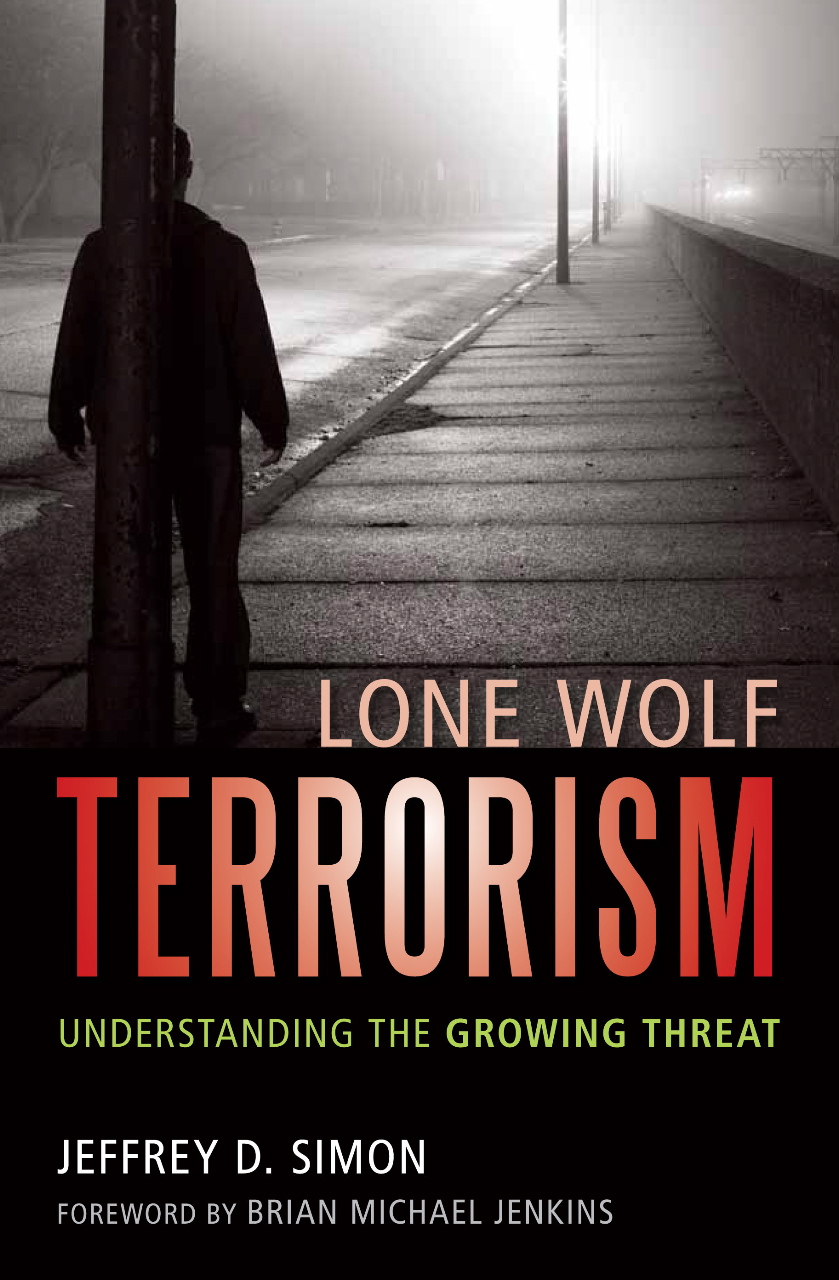
Lone Wolf Terrorism

Cover Lone Wolf Terrorism

 JEFFREY D. SIMON, Ph.D.

When the Irish Republican Army failed in an attempt to assassinate British Prime Minister Margaret Thatcher in 1984, the terrorist group issued the following chilling statement: “Today we were unlucky, but remember, we only have to be lucky once.  You will have to be lucky always.”  In those brief words, the IRA got to the heart of the problem of combating terrorism.  No government or society can realistically expect to always be “lucky” against terrorists since the targets of terrorists are limitless and their strategies and tactics are always evolving.

And that is where the lone wolf terrorist comes into play.  As difficult as it is to try to prevent terrorist groups and cells from perpetrating a major attack, it is even more difficult to prevent a lone wolf from doing so.  In my new book, Lone Wolf Terrorism: Understanding the Growing Threat, I try to unravel some of the unique aspects of the lone wolf threat and outline some steps that can be taken to try to reduce the risk of attacks.

I first became interested in lone wolf terrorism when I conducted a case study of an individual (Muharem Kurbegovic) who had terrorized Los Angeles in the 1970s.  Known as the “Alphabet Bomber” he single-handedly brought the city to a standstill and caused widespread fear by his actions and threats, which included a deadly bombing at Los Angeles International Airport and threats to unleash nerve gas over populated areas.  It was then that I realized that the lone wolf could be a powerful actor in the world of terrorism.  In fact, lone wolves have proven to be as dangerous, and have as much of an impact upon governments and societies as the better-trained and organized terrorist groups and cells.

Recent years have witnessed several major attacks by individual terrorists, ranging from Anders Breivik’s massacre of scores of youths on an island in Norway shortly after setting off a bomb in Oslo to Maj. Nidal Malik Hasan who is accused of killing thirteen fellow soldiers and others at Fort Hood, Texas.  The fact that Breivik is an anti-Islamic extremist and Hasan is an Islamic extremist, underscores the diversity in the growing lone wolf terrorist threat.  Lone wolves come from all parts of the political and religious spectrum.  There have also been terrorist incidents and plots by neo-Nazis, white Supremacists, and “single-issue” extremists.

One of the factors that distinguish lone wolf terrorists from those who are members of a group or cell is their freedom to act upon any scenario they might think up.  There is no group decision-making process or group pressure to stifle creativity.  This has resulted in some of the most innovative terrorist attacks in history.  For example, lone wolves were responsible for the first vehicle bombing (1920), major midair plane bombing (1955), hijacking (1961), product tampering (1982) and anthrax letters attack (2001) in the United States.  Lone wolves think outside the box, which is an advantage in trying to come up with new ideas for terrorist attacks.

Lone wolves are also dangerous because the have little or no constraints on their level of violence.  They are not concerned with alienating supporters (as would many terrorist groups) nor are they concerned with a potential government crackdown following an attack.  That is why they are potential candidates to use weapons of mass destruction (WMD).  There has already been a bioterrorist attack (the anthrax letters) committed by a lone wolf in the U.S.  Lone wolves have no supporters or financial and political backers who might be alienated by a WMD attack and no headquarters or training camps that could be hit in retaliatory raids.  A lone wolf might also believe that committing a conventional terrorist attack similar to those occurring regularly around the world would not yield as much publicity and notoriety as an attack with a chemical, biological, or nuclear weapon.

Lone wolves are also more difficult to identify and capture since they work alone.  There are usually no communications to intercept or members of a group to arrest and learn about potential plots.  They can also sometimes by mentally unstable, yet still very effective, such as Theodore Kaczynski, the infamous Unabomber, who sent package bombs throughout the United States from 1978 to 1995.

Although lone wolves have been active in the past, we are witnessing a new wave of attacks due to the revolutionary impact of the Internet.  The Internet is at the center of what I label as the Technological Wave of terrorism.  Technology is there for all to take advantage of, including lone wolves.  If the Internet did not exist, lone wolves would probably have had to invent it.  They use the Internet for a variety of purposes.  This includes conducting online research for targets, tactics and weapons; becoming self-radicalized by visiting terrorist websites and/or engaging in extremist chat rooms; and posting blogs and manifestos online, sometimes announcing to the world what they intended to do.  For example, Anders Breivik, the Norwegian lone wolf, posted a 1500-page manifesto shortly before his attack where he extolled the virtues of killing large numbers of people for maximum publicity.  In another case, an American woman, Coleen LaRose, who identified herself as “Jihad Jane” in her online postings, used the Internet in an attempt to form her own terrorist network.

It is this desire to communicate through the Internet that provides one of the best opportunities to identify potential lone wolves before they strike.  Through the monitoring of the Internet (without violating law abiding individuals’ civil liberties) much can be learned about who the lone wolves are.  This includes the identification of individuals who, as noted above, are visiting extremist chat rooms, purchasing bomb making materials and other suspicious items online, or posting threatening blogs or manifestos.  Additional strategies that may prove helpful in preventing lone wolf attacks are the expansion closed circuit television (CCTV) cameras in public settings, improved detection devices in post offices and other facilities to identify package bombs or letters containing anthrax spores, and further advances in biometrics, including the use of gait analysis which assesses how somebody is walking to determine if a person may be carrying a bomb or other weapon.  Increased public awareness is another important strategy, such as the reporting of unattended packages in airports, bus terminals, shopping malls, and other potential targets for a terrorist attack.

The lone wolf is forcing us to rethink some of our basic concepts about terrorism.  No longer can we view terrorism as emanating solely from organized or decentralized groups and cells.  The lone wolf has proven to be a formidable foe in the battle against terrorism.  This is likely to continue in the years ahead.


Jeffrey D. Simon is an internationally recognized author, lecturer, and consultant on terrorism and political violence. He is president of Political Risk Assessment Company., Inc., and a visiting lecturer in the Department of Political Science at UCLA.  His most recent book, Lone Wolf Terrorism: Understanding the Growing Threat, was published in 2013(http://www.prometheusbooks.com/index.php?main_page=product_info&cPath=57_66&products_id=2155).  A former RAND analyst, Dr. Simon has conducted research and analysis on terrorism for more than twenty-five years.  His writings on terrorism, political violence, and political risk have appeared in many publications, including the Journal of the American Medical Association, Foreign Policy, and the New York Times.  His website can be found at www.futureterrorism.com.