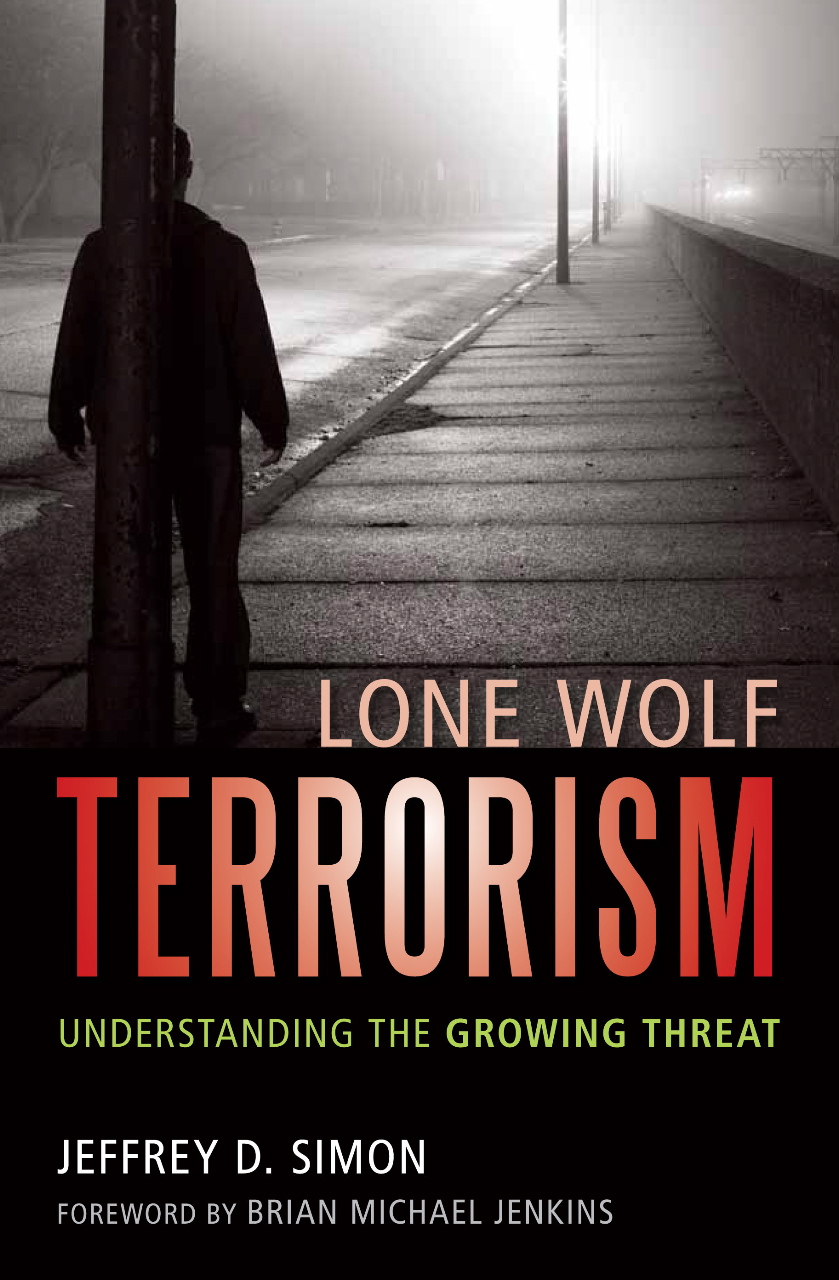
Lone Wolf Terrorism

Cover Lone Wolf Terrorism

 JEFFREY D. SIMON, Ph.D.

When the Irish Republican Army failed in an attempt to assassinate British Prime Minister Margaret Thatcher in 1984, the terrorist group issued the following chilling statement: “Today we were unlucky, but remember, we only have to be lucky once.  You will have to be lucky always.”  In those brief words, the IRA got to the heart of the problem of combating terrorism.  No government or society can realistically expect to always be “lucky” against terrorists since the targets of terrorists are limitless and their strategies and tactics are always evolving.

And that is where the lone wolf terrorist comes into play.  As difficult as it is to try to prevent terrorist groups and cells from perpetrating a major attack, it is even more difficult to prevent a lone wolf from doing so.  In my new book, Lone Wolf Terrorism: Understanding the Growing Threat, I try to unravel some of the unique aspects of the lone wolf threat and outline some steps that can be taken to try to reduce the risk of attacks.

I first became interested in lone wolf terrorism when I conducted a case study of an individual (Muharem Kurbegovic) who had terrorized Los Angeles in the 1970s.  Known as the “Alphabet Bomber” he single-handedly brought the city to a standstill and caused widespread fear by his actions and threats, which included a deadly bombing at Los Angeles International Airport and threats to unleash nerve gas over populated areas.  It was then that I realized that the lone wolf could be a powerful actor in the world of terrorism.  In fact, lone wolves have proven to be as dangerous, and have as much of an impact upon governments and societies as the better-trained and organized terrorist groups and cells.

Recent years have witnessed several major attacks by individual terrorists, ranging from Anders Breivik’s massacre of scores of youths on an island in Norway shortly after setting off a bomb in Oslo to Maj. Nidal Malik Hasan who is accused of killing thirteen fellow soldiers and others at Fort Hood, Texas.  The fact that Breivik is an anti-Islamic extremist and Hasan is an Islamic extremist, underscores the diversity in the growing lone wolf terrorist threat.  Lone wolves come from all parts of the political and religious spectrum.  There have also been terrorist incidents and plots by neo-Nazis, white Supremacists, and “single-issue” extremists.

One of the factors that distinguish lone wolf terrorists from those who are members of a group or cell is their freedom to act upon any scenario they might think up.  There is no group decision-making process or group pressure to stifle creativity.  This has resulted in some of the most innovative terrorist attacks in history.  For example, lone wolves were responsible for the first vehicle bombing (1920), major midair plane bombing (1955), hijacking (1961), product tampering (1982) and anthrax letters attack (2001) in the United States.  Lone wolves think outside the box, which is an advantage in trying to come up with new ideas for terrorist attacks.

Lone wolves are also dangerous because the have little or no constraints on their level of violence.  They are not concerned with alienating supporters (as would many terrorist groups) nor are they concerned with a potential government crackdown following an attack.  That is why they are potential candidates to use weapons of mass destruction (WMD).  There has already been a bioterrorist attack (the anthrax letters) committed by a lone wolf in the U.S.  Lone wolves have no supporters or financial and political backers who might be alienated by a WMD attack and no headquarters or training camps that could be hit in retaliatory raids.  A lone wolf might also believe that committing a conventional terrorist attack similar to those occurring regularly around the world would not yield as much publicity and notoriety as an attack with a chemical, biological, or nuclear weapon.

Lone wolves are also more difficult to identify and capture since they work alone.  There are usually no communications to intercept or members of a group to arrest and learn about potential plots.  They can also sometimes by mentally unstable, yet still very effective, such as Theodore Kaczynski, the infamous Unabomber, who sent package bombs throughout the United States from 1978 to 1995.

Although lone wolves have been active in the past, we are witnessing a new wave of attacks due to the revolutionary impact of the Internet.  The Internet is at the center of what I label as the Technological Wave of terrorism.  Technology is there for all to take advantage of, including lone wolves.  If the Internet did not exist, lone wolves would probably have had to invent it.  They use the Internet for a variety of purposes.  This includes conducting online research for targets, tactics and weapons; becoming self-radicalized by visiting terrorist websites and/or engaging in extremist chat rooms; and posting blogs and manifestos online, sometimes announcing to the world what they intended to do.  For example, Anders Breivik, the Norwegian lone wolf, posted a 1500-page manifesto shortly before his attack where he extolled the virtues of killing large numbers of people for maximum publicity.  In another case, an American woman, Coleen LaRose, who identified herself as “Jihad Jane” in her online postings, used the Internet in an attempt to form her own terrorist network.

It is this desire to communicate through the Internet that provides one of the best opportunities to identify potential lone wolves before they strike.  Through the monitoring of the Internet (without violating law abiding individuals’ civil liberties) much can be learned about who the lone wolves are.  This includes the identification of individuals who, as noted above, are visiting extremist chat rooms, purchasing bomb making materials and other suspicious items online, or posting threatening blogs or manifestos.  Additional strategies that may prove helpful in preventing lone wolf attacks are the expansion closed circuit television (CCTV) cameras in public settings, improved detection devices in post offices and other facilities to identify package bombs or letters containing anthrax spores, and further advances in biometrics, including the use of gait analysis which assesses how somebody is walking to determine if a person may be carrying a bomb or other weapon.  Increased public awareness is another important strategy, such as the reporting of unattended packages in airports, bus terminals, shopping malls, and other potential targets for a terrorist attack.

The lone wolf is forcing us to rethink some of our basic concepts about terrorism.  No longer can we view terrorism as emanating solely from organized or decentralized groups and cells.  The lone wolf has proven to be a formidable foe in the battle against terrorism.  This is likely to continue in the years ahead.


Jeffrey D. Simon is an internationally recognized author, lecturer, and consultant on terrorism and political violence. He is president of Political Risk Assessment Company., Inc., and a visiting lecturer in the Department of Political Science at UCLA.  His most recent book, Lone Wolf Terrorism: Understanding the Growing Threat, was published in 2013(http://www.prometheusbooks.com/index.php?main_page=product_info&cPath=57_66&products_id=2155).  A former RAND analyst, Dr. Simon has conducted research and analysis on terrorism for more than twenty-five years.  His writings on terrorism, political violence, and political risk have appeared in many publications, including the Journal of the American Medical Association, Foreign Policy, and the New York Times.  His website can be found at www.futureterrorism.com.

Between Welfare And Warfare: The Two-Faced Character Of Hamas

WRITTEN BY: CAMILLA GIOVANNINI

The article aims to point out the double nature, as welfare agency and, at the same time, as armed group, of Hamas, leaving apart the theoretical issue concerning the definition of terrorism and focusing on the implications that this ambivalence implies from an international perspective, specially connected to the blacklisting.


Hamas, the acronym of Harakat al Muqāwama al Islāmiyya (Islamic Resistance Movement), was established in Gaza in 1987 as the Palestinian branch of the Muslim Brotherhood[1]. This latter was founded by the schoolteacher Hasan al Banna in Egypt in 1928. At the beginning it was a trade union for Arab and Egyptian workers employed in constructing the Suez Channel. It aimed to promote a culture of solidarity from an Islamic perspective. Ten years after its foundation the organization could count 500.000 members, belonging primarily to the poorest levels of the society. Recalling the traditional Islamic values the league promoted a political view of Islam, also through the opening of  “islamized places”, where relations were involved just among Muslims, without any western contamination. In order to achieve its goals it rooted in the mosques through the means of preaching, da’wa, and was very active in the social services and welfare system. Its presence in the educational and social agencies has been a feature still today, verifiable within the Brotherhood and its affiliate organizations, among them, precisely, Hamas.

As its parental organization, Hamas’ attention and commitment towards the people is a distinctive character which connotes its action and, at this regard, article 21 of the Covenant of Hamas states: “Mutual social responsibility means extending assistance, financial or moral, to all those who are in need and joining in the execution of some of the work. Members of the Islamic Resistance Movement should consider the interests of the masses as their own personal interests”.

The Covenant helps also to figure out the movement’s goals and ideology. Article 1 concerns Islam, perceived as origin and source of interpretation: “The Movement’s programme is Islam. From it, it draws its ideas, ways of thinking and understanding of the universe, life and man. It resorts to it for judgment in all its conduct, and it is inspired by it for guidance of its steps”. From the religion springs the awareness about the conditions of the Palestinian people and the decision to fight: “The basic structure of the Islamic Resistance Movement consists of Moslems who have given their allegiance to Allah whom they truly worship, – “I have created the jinn and humans only for the purpose of worshipping” – who know their duty towards themselves, their families and country. In all that, they fear Allah and raise the banner of Jihad in the face of the oppressors, so that they would rid the land and the people of their uncleanliness, vileness and evils[2].

With regard to Israel and its existence, the statute is clear: “Moreover, if the links have been distant from each other and if obstacles, placed by those who are the lackeys of Zionism in the way of the fighters obstructed the continuation of the struggle, the Islamic Resistance Movement aspires to the realization of Allah’s promise, no matter how long that should take. The Prophet, Allah bless him and grant him salvation, has said:

“The Day of Judgment will not come about until Moslems fight the Jews, when the Jew will hide behind stones and trees. The stones and trees will say O Moslems, O Abdulla, there is a Jew behind me, come and kill him. Only the Gharkad tree would not do that because it is one of the trees of the Jews.” [3]. The goal of Hamas is to eliminate the State of Israel and to replace it with an Islamist State in all of what was once the land covered by the British mandate, since Palestine is a waqf, an holy endowment, which has to be Islamic[4]. Accordingly, in 2006, when the organization won the political election in Gaza, it imposed in the Strip a strict observation of sharī‘a.

The slogan of Hamas, at article 8, is an effective summary of the organization’s belief: “Allāh is its target, the Prophet is its model, the Qur’an its constitution: jihād is its path and death for the sake of Allāh is the loftiest of its wishes”.

In order to achieve its aims, Hamas is committed in social welfare activities: the organization’s annual budget is estimated in 70 million dollars[5] and the substantial part of it, the 75-80%[6], is devoted to the social services network, which has ensured that support to the organization, which led this latter to the electoral victory. Moreover, it is engaged in political activity and in guerilla and terrorist attacks against Israeli soldiers and civilians. The political wing has always had the control on the entire organization, hence also on the military component: the ‘Izz al Dīn al Qassām Brigades, for which it buys weapons and raises funds. The military wing, in turn, takes part to the decision making process even with regard to the political issues[7].

Starting from 1988, Hamas has begun to act, for first just in the Gaza Strip, then also in Judea and Samaria, targeting villages and towns and taking hostages. There has never been any distinction between soldiers and civilians because: “Every Jew or settler is a target and must be killed. Their blood and their property are forfeit[8]. In Mehola (Israel), April 16, 1993, Hamas opened the season of the suicide terrorism with a car bomb, bringing in the Israeli cities the same dynamics that, ten years before, Hizballāh used in Lebanon. This deadly campaign, which increased in the ‘90s and during the so-called “second intifada”, was responsible for the 40% of all the attacks and caused the 44% of the victims of terrorism in Israel[9].

Hamas’ social services, made of mosques, hospitals, orphanages, schools, religious societies, associations and sport teams, attract funding from abroad, through charitable societies and benefactor States, among them, for instance, Iran, as it was proven once again[10] during the last war in Gaza in the end of 2012, and Syria which also hosted the organization’s foreign contingent, also known as the external leadership, until November 2012. This latter has been in charge of keeping relations with the third Countries: Yemen as well as Iran. Syrian support was granted to Hamas by Hāfiz Assad and then by his son Bashār. The Country is a communication route with Iran, crossed by persons, goods and weapons, and a hosting territory for training camps[11].

Through the Islamic duty of zakāt, charities controlled by Hamas, for instance the Union of Good[12], collect a huge flow of money, especially from Saudi Arabia[13]. However, the Kingdom has been undertaking some agreements with Israel, since the support to the Palestinian cause should be seen from a wider perspective, inserted in the Middle-east chessboard, which implies the struggle for the control on the Region. Thus, from 2001, the flow of funds from Saudi Arabia to Hamas has been progressively reduced in a way inversely proportional to the increasing Iranian funds[14].

In 2003 the European Union listed Hamas in its terror blacklist, replacing the ‘Izz al Dīn al Qassām Brigades (in the list since 2001), opting for an unified consideration of the organization. The European awareness to be dealing with an unique, even articulated, movement has been the result of a different approach, antithetic to the previous one, which was used to split the military from the political wing. National authorities do not always confirm the Community decision: the United Kingdom has blacklisted just the Brigades, due to the consideration towards the organization’s social activities; furthermore, France keeps open channels and relations with it[15]. Outside the Union, Australia and New Zealand have taken the same decision of the Great Britain, on the contrary, United States and Canada have blacklisted the entire organization. In 2006 the Russian newspaper Rossiiskaya gazeta published the list of the terrorist groups drawn up by the Supreme Court of the Russian Federation. According to the words of the general Yuri Sapunov, at that time head of the antiterrorism at the Federal Security Service, the absence, in the list, of Hamas and of the Brigades was justified by the unclearness, on the international scene, about the nature of the organization. Moreover Hamas, and the Brigades as well, did not represent a threat to the Russian security, since they were not linked to the groups operating in Caucasus[16].

With regard to Hamas, as we have seen, the European Union reached the unanimity required by the Council Regulation 2580/2001 in order to list Hamas and to impose on it the provided restrictive measures. On the contrary, this consensus has always been missing when Hizballāh is at stake. Although also recently, after the suicide bombing of a bus full of Israeli tourists in the Bulgarian city of Burgas, Germany[17], United Kingdom and Netherland[18] have called for banning the Lebanese group, the European Governments are not able to find a common position about. Within the Union, just Netherland and Germany have banned Hizballāh, while Great Britain blacklisted only its military wing.

This disagreement is caused by organization’s relevance as social agency in Lebanon. As well as Hamas, the movement since its origin has been committed in providing assistance and services to the Lebanese Shi’ite community, hospitals, schools, summer camps, and creating job positions for the people from the southern quarters of Beirut and the Bekaa Valley.  However these agencies are also finalized to the recruitment of new members for joining the group. Hizballāh uses its summer camps to indoctrinate youngsters with its ideology, celebrating the terrorist culture, teaching to hate Israel, feeding the cult for Hassan Nasrallah’s personality and glorifying the organization’s martyrs[19].

Hamas services too are basins of votes and laborers: the funds are used for financing the social agencies, helping the poorest but also for buying weapons and for sustaining the families of those who were killed or imprisoned during the operations against Israel. Schools and summer camps for children and kids, which host 100.000 minors every year, are places aimed also to indoctrinate the young generations, training them to the hate for Israel, to the military techniques and to the charm of the martyrdom. The following example is a grammar exercise taken from a schoolbook provided by Hamas: “Believers who sit at home, other than those who are disabled, are not equal with those who strive and fight in the cause of Allah with their wealth and their lives[20].

The European Union, with regard to Hamas, has been able, so far, to perceive that the organization is one, now it is at a crossroads: it is called to decide if it wants to apply the same interpretation to the national blacklisting processes and to Hizballāh or if it wants to make a step back and to remove from the list Hamas’ political wing, keeping it as speaker and including its leadership in the peace deals.


[1] Article 2, The Covenant of the Islamic Resistance Movement, 1988

[2] Ivi, article 3

[3] Ivi, article 7

[4] Ivi, article 11

[5] Jonathan Masters, Hamas, Council on Foreign Relations, last update 27 November 2012, available at the website http://www.cfr.org/israel/hamas/p8968 (last visit 21 February 2013)

[6] David H. Gray, John B. Larson, Grass roots terrorism: how Hamas’s structure defines a policy of counterterrorism, Research Journal of International Studies – Issue 8 (November, 2008), p. 126

[7] Intelligence and Terrorism Information Center, Hamas and the terrorist threat from the Gaza Strip, March 2010

[8] Hamas leaflet 65/1990. Source: Boaz Ganor, Hamas – the Islamic resistance movement in the Territories, International Institute for Counter Terrorism

[9] Intelligence and Terrorism Information Center, Profile of the Hamas movement, February 2006

[10] Saeed K. Dehghan, “Iran supplied Hamas with Fajr-5 missile technology”, The Guardian, 21 November 2012, available at the website http://www.guardian.co.uk/world/2012/nov/21/iran-supplied-hamas-missile-technology (last visit 6 March 2013). Iranian support to Hamas has been ensured also through Hizballāh, which has provided its infrastructures to Iranian instructors training Hamas’ members

[11] See supra, note 9

[12] Office of the Coordinator for Counterterrorism, Country Reports on Terrorism 2011, U.S. Department of State, available at the website http://www.state.gov/j/ct/rls/crt/2011/195553.htm#hamas (last visit 8 March 2013)

[13] David H. Gray, John B. Larson, see supra note 6, p. 129

[14] See the U.S. Patterns of Global Terrorism, from 2001 on.

[15] Steven Erlanger, “France admits contacts with Hamas”, in The New York Times, 20 May 2008, available at the website http://www.nytimes.com/2008/05/20/world/europe/20france.html (last visit 8 March 2013)

[16]  Robert Parsons, “Russia: Supreme Court approves List of 17 terrorist groups”, in Radio free Europe. Radio liberty, 28 July 2006, available at the web site http://www.rferl.org/content/article/1070179.html (last visit 8 March 2013)

[17] Benjamin Weinthal, “Top German politician calls for EU to ban Hezbollah”, The Jerusalem Post, 23 August 2012, available at the website http://www.jpost.com/International/Article.aspx?id=282357 (last visit 8 March 2013)

[18] News agencies, “UK seeks to add Hezbollah to EU’s terror watch list”, Ynetnews, 7 September 2012, available at the website http://www.ynetnews.com/articles/0,7340,L-4278524,00.html (last visit 8 March 2013)

[19] Intelligence and Terrorism Information Center,

http://www.terrorism-info.org.il/data/pdf/PDF_08_220_2.pdf (last visit 8 March 2013)

[20] Itamar Marcus, “From nationalist battle to religious conflict: New 12th grade Palestinian schoolbooks present a world without Israel”, Palestinian Media Watch, February 2007, available at the website http://www.palwatch.org/STORAGE/special%20reports/SchoolBooks_English_Final_for_web.pdf (last visit 8 March 2013)

Accountability for Torture by United States Since 9/11

WRITTEN BY: JAMES ROTH

James Roth is a retired lawyer, now a writer. He was one of the founders and long-time board member of Advocates For Human Rights and The Center For Victims of Torture.  He is currently completing his first novel entitled “Beyond Torture.” He is also active with many groups working on foreign policy and international human rights issues.

Summary:

Before 9/11 it was widely accepted that torture was illegal under international and United States domestic law. The United States had signed and ratified the Convention Against Torture and had enacted the anti-torture statute of 1994, 18 U.S.C. Sections 2340-2340A , which criminalized acts of torture by United State nationals or non-nationals committed outside the United States, as well as the Torture Victim Protection Act of 1991.

Shortly after 9/11 Bush administration officials sought and received authorization through various legal memos and reports by the Department of Justice and Department of Defense to create detention facilities outside the United States and to use harsher interrogation techniques than those previously approved. The result was the use of “Enhanced Interrogation Techniques” as well as increased renditions of detainees to other countries for interrogation.

Many abuses which have now been well-documented followed including long-term detentions without access to legal counsel or legal oversight, widespread use of interrogation techniques broadly acknowledged as being torture and cruel and unusual punishment, including deaths of over 100 detainees under questionable circumstances.

Upon taking office in January 2009, President Obama issued Executive Order 13491—Ensuring Lawful Interrogations. Yet, despite well-documented violations of international and domestic laws no clear standards have emerged and there has been no accountability except for a handful of lower level military personnel.

This article outlines a number of areas, both legislative and domestic, that it urges our Congressional Representatives and Senators to pursue.

Specifically, this article urges action to confront the United States Congress to:

  1. Release to the public the December 2012 Senate Intelligence Committee Report with as few redactions as possible so that the public can understand what brought about the shift in U.S. policy toward torture and cruel treatment and diminished America’s longstanding consensus against torture and cruel treatment.
  2. Request that President Obama release in some form the report(s) by the Special Interagency Task Force on Interrogation and Transfer Policies established under Executive Order 13491.
  3. Issue an apology to Canadian citizen Mahar Arar, who was mistakenly retained and rendered to Syria where he was tortured, and to Khalid El-Masri, a Lebanese-Canadian who was kidnapped by the CIA in Macedonia where he was tortured and then flown to Afghanistan and tortured some more until the CIA discovered that it had the wrong person and dumped him on an isolated street in Albania.
  4. Ask the Office of the Inspector General for the CIA to supplement the 2004 Report in light of recently obtained information contained in a Human Rights Watch Report of alleged waterboarding and other abuses of detainees in Libya.
  5. Ask Attorney General Holder to investigate the alleged abuses in Libya.
  6. Take appropriate action to encourage local communities to accept detainees from Guantanamo who have been exonerated.
  7. Assure that appropriate oversight is established and maintained so that torture and cruel treatment does not occur in the future.

Background

On September 14, 2001 President Bush issued the “Declaration of National Emergency by reason of Certain Terrorist Attacks.”[1] On September 17, 2001 President Bush issued a 12-page directive (known as a “memorandum of notifications) to the Director of the CIA and members of the National Security Council authorizing the CIA to capture suspected terrorists and members of Al-Qaeda and to create detention facilities outside the United States to hold and interrogate them.[2]  The International Committee of the Red Cross was refused access to detainees held in the new CIA program until September 2006.[3] On November 13, 2001 President Bush authorized the detention of alleged terrorists and subsequent trial by military commission, which he ordered would not be subject to the principles of law and rules of evidence applicable to U.S. federal courts.[4]

On July 11, 2002, the first detainees arrived in Guantanamo Bay, Cuba. On January 18, 2002 President Bush declared that the Third Geneva Conventions did not apply to the conflict with Al Qaeda or the Taliban and that they would not receive the protections afforded to prisoners of war.[5] On February 7, 2002 President Bush issued a memorandum to that effect.[6] In so doing, the President rejected the requests by Secretary of State Colin Powell to reconsider and reverse his decisions,[7] as well as the advice of William H. Taft, IV, Legal Adviser to the State Department, that these decisions were inconsistent with the plain language of the Geneva Conventions and contravened the unvaried interpretation and practice in the fifty years since the United States became a party of the Conventions.[8]

In March 2002, the first “high value detainee”, Abu Zubaydah, was detained and interrogated by the CIA.[9]  The CIA interrogation program sanctioned by President Bush included interrogation techniques adapted from the Survival Evasion Resistance Escape (“SERE”) training program in which U.S. military members were exposed to and taught to resist interrogation techniques used by countries that did not adhere to the Geneva Conventions.[10] As reported in the later CIA Inspector General Report, the U.S. now employed these techniques itself, including waterboarding, confining detainees in a dark box with insects, up to 11 days of sleep deprivation, facial holds and slaps, “walling” (pushing a detainee against a wall) and use of stress positions.[11]

On November 27, 2002 William J. Haynes, General Counsel for the Department of Defense, provided to Donald Rumsfeld an “Action Memo regarding Counter-Resistance Techniques seeking approval of three categories of counter-resistance techniques to aid in the interrogation of detainees at Guantanamo Bay.” Rumsfeld initialed his approval on December 2, 2002 to the first two categories and one of the techniques from the third category (“mild non-injurious physical contact”). This signaled approval of the SERE enhanced interrogation techniques by the military in addition to the CIA. This is one example of the migration of lists and interrogation techniques beyond those approved by the Army Field Manual. U.S. Army General Geoffrey D. Miller was given command of Joint Task Force Guantánamo in November 2002. He implemented the new harsh techniques there. In August 2003 Miller was sent to Iraq by the Department of Defense to help get more information out of Iraqi prisoners. In September Miller submitted a report recommending “GTMO-ising” interrogation techniques–combining the detention and interrogation units at Abu Ghraib into the Theater Joint Interrogation and Detention Center. Miller recommended that prison guards be used to “soften up” prisoners for interrogations.

In September 2003 Lieut. General Ricardo S Sanchez sent a secret cable to US Central Command outlining more aggressive interrogation methods that he planned to authorize immediately, including several that were later revealed when the Abu Ghraib scandal broke.

All of the above facts illustrate how the US military’s ad hoc decision-making created confusion and allowed the harsh methods to infiltrate from Afghanistan to Guantánamo and Iraq. A clear line exists from the initial decision that the Geneva Conventions did not apply to Al Qaeda and Taliban detainees.

As described by the ICRC after they were finally provided with access to detainees, the CIA detention program “included transfers of detainees to multiple locations, maintenance in continuous solitary confinement, incommunicado detention throughout the entire period of their undisclosed detention, and the infliction of further ill-treatment through the use of various methods either individually or in combination, in addition to the deprivation of other basic material requirements.”[12] The ICRC Report further found: “The ability of the detaining authority to transfer persons over apparently significant distances to secret locations in foreign countries actually increased the detainees’ feelings of futility and helplessness, making them more vulnerable to the methods of ill-treatment… these transfers increased the vulnerability… to their interrogation, and was performed in a manner (goggles, earmuffs, use of diapers, strapped to stretchers, sometimes rough handling) that was intrusive and humiliating…”[13]

The United Nations Joint Study on secret detentions found that the CIA had taken detainees who were held in Afghanistan, Thailand, Poland, Romania and other locations. [14]The UN Joint Study further found the CIA “had taken 94 detainees into custody and had employed enhanced interrogation techniques to varying degrees in the interrogation of 28 of those detainees.”[15]

It has been documented that over 100 detainees died while in US custody, many under suspicious circumstances. [16]

The interrogation techniques used on detainees were euphemistically described as “enhanced interrogation techniques” by the US government, but the United Nations and the International Committee of the Red Cross found that they rose to the level of torture and cruel, inhuman and degrading treatment. [17]

Alberto J. Mora served as General Counsel to the U.S. Navy from 2001 to 2006. Upon learning of the authorization of the use of coercive interrogation techniques by the US he stated:

“To my mind, there’s no practical distinction [between cruelty and torture]. If          cruelty is no longer declared unlawful but instead is applied as a matter of policy, it alters the fundamental relationship of man to government. It destroys the whole notion of individual rights. The Constitution recognizes that man has an inherent right, not bestowed by the state or laws, to personal dignity, including the right to be free of cruelty. It applies to all human beings, not just in America—even those designated as ‘unlawful enemy combatants.’ If you make an exception the whole Constitution crumbles.

Besides, my mother would have killed me if I hadn’t spoken up. No Hungarian after communism, or Cuban after Castro, is not aware that human rights are incompatible with cruelty. The debate here isn’t only how to protect the country. It’s how to protect our values.”

On June 22, 2009 Pres. Barack Obama signed Executive Order 13491–Ensuring Lawful Interrogations. In section 3(b) it provided:

Effective immediately, an individual in the custody or under the effective control of an officer, employee, or other agent of the United States government, or detained within a facility owned, operated or controlled by a department or agency of the United States, in any armed conflict, shall not be subjected to any interrogation technique or approach, or any treatment related to interrogation that is not authorized by Army Field Manual 2 22.3.

In section 4(a) the order provided “ The CIA shall close as expeditiously as possible any detention facilities that it currently operates and shall not operate any such detention facility in the future.”

The Order also created a special interagency task force on interrogation and transfer policies. The task force was told to provide a report to the president within 180 days unless an extension was necessary.

The Order required the CIA to use only 19 interrogation methods outlined in the United States Army Field manual on interrogations “unless the Atty. Gen. with appropriate consultation provides further guidance.”

It is unknown whether extraordinary renditions have been carried out since 2009.

Addendum A

Mahar Arar

Mahar Arar is a Canadian citizen who emigrated with his family from Syria at age 17. On September 26, 2002 he was detained by U.S. officials at JFK Airport in New York and interrogated about alleged links to al-Qaeda. Twelve days later he was chained, shackled and flown to Syria where he was held in a tiny “grave-like” cell for over then months. He was beaten, tortured and forced to make a false confession.

His wife, Mosia Mazigh, learned of his imprisonment and campaigned for his release. He was returned to Canada in October 2003. On January 24, 2004 the Canadian government established a Commission of Inquiry to review his treatment by Canadian officials. On September 18, 2006 the Commission of Inquiry cleared Arar of all charges stating “categorically there is no evidence to indicate that Mr. Arar has committed any offense or that his activities constitute a threat to the security of Canada.”

The government of Canada settled the case out of court and paid Arar $10.5 million (Canadian) and Prime Minister Stephen Harper formally apologized to Arar.

In contrast, in 2004 Arar brought a lawsuit in the U.S. in federal court in New York against John Ashcroft and others. The U.S. invoked the “state secrets privilege” and moved to dismiss the lawsuit. It was dismissed and upheld on appeal. Upon rehearing the Chief Judge of the Second Circuit Court of Appeals wrote, “If a civil remedy in damages is to be created for the harms suffered in the context of extraordinary renditions, it must be created by Congress…”

The U.S. Supreme Court declined to accept review of the case.  The U.S. government has taken no steps to make amends to Mr. Arar and his family.

Khalid El-Masri

In a recent landmark decision, the European Court of Human Rights unanimously ruled in favor of Mr. El-Masri on December 12, 2012, corroborating details of his abduction and torture by the CIA and holding that the CIA’s treatment of Mr. El-Masri was torture.

Mr. El-Masri is a Lebanese-Canadian who was kidnapped by the CIA is Macedonia. With the assistance of the Macedonian government he was held incommunicado, severely beaten, sodomized, shackled and hooded, submitted to total sensory deprivation and harshly interrogated for over three weeks. He was then flown to Afghanistan where he was incarcerated in a small, dirty dark brick factory and beaten, kicked, threatened and interrogated for more than four months. When the CIA ultimately learned that he was the wrong person he was dumped on an isolated street in Albania.

In contrast, when Mr. El-Masri brought a case in the U.S. it was dismissed and upheld on national security grounds, as in Mr. Arar’s case, and again the U.S. Supreme Court refused to accept review of his case.

United Nations Special Rapporteur on Human Rights and Counter-Terrorism Ben Emmerson described the European Court of Human Rights ruling as “a key milestone in the long struggle to secure public accountability of public officials implicated in human rights violations committed by the Bush administration CIA in its policy of secret detention, rendition and torture.” He said that the U.S. government must issue an apology for its “central role in the web of systematic crimes and human rights violations by the Bush-era CIA, and to pay voluntary compensation to Mr. El-Masri.”

To date the U.S. government has not responded.


[2] The directive has not yet been publicly released. But see George Tenet, at the Center of the Storm: the CIA During America’s Time of Crisis 208  (Harper 2007).

[3]  ICRC, Report to John Rizzo, Acting General Counsel, CIA. ICRC Report on the Treatment of Fourteen “High Value Detainees” in CIA Custody, 14 February 2007, available at http://www.nybooks.com/doc/2010/04/22/icrc-report.pdf

[4] Military Order of November 13, 2001:Detention, Treatment and Trial of Certain Non-Citizens in the War Against Terrorism, Federal Register, Vol. 66, No.2, 16 November 2001, pp. 57831-36

[5] John Yoo and Robert Delahunty, Memorandum for William J. Haynes, II, General Counsel, Department of Defense, January 9, 2002.

[6] George Bush, The White House, Memorandum for the Vice President, et al, Harsh Treatment of Taliban and al-Qaeda detainees (7 February 2002).

[7] Alberto R. Gonzalez, Memorandum for the President, Decision re Application of the Geneva Conventions to Prisoners of War to the Conflict with Al Qaeda and the Taliban (25 January 2002).

[8] William H. Taft, IV, Legal Adviser, Department of State, Memorandum to Counsel to the President, Alberto Gonzalez, Comments on Your Paper on the Geneva Conventions (2 February 2002).

[9] CIA Inspector General’s Special Review: Counterterrorism, Detention, and Interrogation Activities, September 2001-October 2003, dated 7 may 2004 and publicly released on 24 August 2009, at 12 “CIA IG Report”).

[10] CIA IG Report at 21-22, fn. 26 and 37.

[11] A list of techniques is found in the CIA IG Report at 15.

[12] ICRC CIA Detainee Report at 4.

[13] ICRC CIA Detainee Report at 7. It is notable that the ICRC Report details the same interrogation techniques outlined in the CIA IG Report, which was not publicly available at the time.

[14] 14.       United Nations Human Rights Council, Joint Study on Global Practices in Relation to Secret Detention in the Context of Countering Terrorism of the Special Rapporteur on the promotion and protection of human rights and fundamental freedoms while countering terrorism, the Special Rapporteur on torture and other cruel, inhuman or degrading treatment or punishment, the working group on arbitrary detention, and the Working Group on Enforced or Involuntary Disappearances, A/HRC/13/42, 19 February 2010, at 45-50 (“UN Joint Study”).

[15] UN Joint Study at para. 103.

[16] Testimony of Lawrence Wilkerson, Chief of Staff to Colin Powell U.S. Secretary of State, 2001-2005, before U.S. House of Representatives Judiciary Subcommittee on Civil Rights, June 18, 2008

[17] ICRC CIA Detainee Report, at 5, UN Joint Study at 45-50.

Enforcing ICL: The Iran Tribunal and the Rios Montt Trial

WRITTEN BY: REGINA PAULOSE

“Silence is the most powerful scream” – Anonymous

There are many incidents that have violated International Criminal Law (ICL) that have taken place in global history but have never been presented to a “legitimate” tribunal for consideration.  Thankfully, this has not stopped victims from finding a way to address the wrongs that have been committed against them. After WWII, the Nuremburg Tribunals showcased that perpetrators of horrible crimes would face punishment by the international community (or at least by the victors of war). Unfortunately, as history continued to unfold, it became clear that whenever an atrocity occurred it did not necessarily mean that every perpetrator would be held accountable for violations of ICL.

Circa 1966, Playwright Bertrand Russell and Philosopher Jean Paul Sartre created the “Russell Tribunal” which investigated crimes alleged to have been committed by the U.S. during the Vietnam War.[1] As Jean Paul Sartre eloquently described,

“[t]he Russell Tribunal was born of this doubly contradictory conclusion: the judgment of Nuremberg had necessitated the existence of an institution to inquire into war crimes and, if necessary, to sit in judgment; today neither governments nor the masses are capable of forming one. We are perfectly aware that we have not been given a mandate by anyone; but we took the initiative to meet, and we also know that nobody could have given us a mandate. It is true that our Tribunal is not an institution. But, it is not a substitute for any institution already in existence: it is, on the contrary, formed out of a void and for a real need.”[2]

These activists envisioned that one day the world would have a permanent court to address war crimes, crimes against humanity, and genocide. Philosophically, the ad-hoc tribunals and the ICC are the ideals that Sartre envisioned in his inaugural address. In reality, “selective justice” has continued to cripple the international rule of law. However, as the Iran Tribunal and the Rios Montt Trial prove, citizens are moving together to force open the doors of justice to accommodate them so that they can determine their own truths for the atrocities they have witnessed.

Iran Tribunal

Inspired by the Russell Tribunal, survivors, families of deceased victims, activists, and scholars, created an “Iran Tribunal” to address the atrocities that were committed in the 1980’s by the ruling regime in Iran.[3]  The Tribunal specifically focused on the atrocities committed from 1981-1988. Ayatollah Khomeini appointed a provisional government in 1979. This provisional government began to arrest previous regime members and members of political organizations who spoke out against the Islamic regime. It is estimated from these actions, that approximately 15,000 people were arrested, tortured, and summarily executed.

The Tribunal heard and documented detailed evidence that showed the regime’s use of forced disappearances, various kinds of torture, massive rapes, and other forms of cruel and inhumane treatment of prisoners. Witnesses who came before the Tribunal also gave names of hundreds of victims who were executed without any due process. They described how these prisoners were held for as little as three days and executed by a firing squad or by hanging.

In addition there was testimony regarding various massacres that took place. The Jahrom Massacre was described as follows:

“After Mahmoud Vatanparast, the Governor of Fars Province, refused to rig the province’s parliamentary election results in 1980 in favour of Mohammed Behsarati, a losing candidate, the shari’ah leader of Jahrom ordered the murder of Vatanparast’s entire family from the pulpit of the mosque. Several family members where then summarily executed, including by crucifixion, defenestration, skinning alive, being cut into pieces with shears, and being dragged along the asphalt behind a moving van. Children as young as nine were arrested; others were incarcerated and then killed under torture or in the massacres of 1988. After inhabitants of Jahrom smelt a foul odour coming out of a canal, seventeen dead children were shortly found in the water.”[4]

During the Rasht Prison Fire, several inmates burned to death as guards would not open their cells to allow them to escape the flames. There were massacres in Kurdistan, where hundreds of Kurds were killed in an airport and children were executed in front of their schools.  The regime also used “pardon commissions” but it was commonly referred to as “death commissions.” Prisoners would be brought before the commission and questioned as to their religious/political beliefs. If the commission did not approve of their answer, the prisoners would be taken out and executed.

In its Findings, the Tribunal documented the perpetrators involved and the various locations where these crimes took place. In the Final Judgment  the Tribunal held that the “evidence tendered in these hearings supports a finding that crimes were committed by agents of the Islamic Republic of Iran, beginning with the Supreme Leader, and ending with the executions in the prisons and these constitute a breach of international law.”[5] It concluded that the Islamic Republic of Iran committed crimes against humanity during the 1980-1989 period.

Rios Montt Trial

The Iran Tribunal is not an isolated incident of victims demanding justice for the heinous acts of its leaders. In Guatemala, the road to bring Rios Montt to trial for his actions in 1982-1983 for genocide and crimes against humanity was a long one.

“Guatemalan victims’ organizations filed a war crimes case against the general in 2001, but it got stuck in the country’s legal system. Years later, under the principle of universal jurisdiction, the Spanish Constitutional Court accepted a case that had been brought by Nobel laureate Rigoberta Menchú charging Ríos Montt and seven other commanders with genocide, terrorism and torture. A tenacious lawyer named Almudena Bernabeu began the investigation. In 2006 a Spanish court issued arrest orders for the general and others, but the Guatemalan government denied extradition. When Ríos Montt was later elected to Congress, he gained immunity from prosecution. Then another extraordinarily brave woman stepped in. After Claudia Paz y Paz became Guatemala’s attorney general in 2010, she filed a case against Ríos Montt (after his term ran out) and two other military commanders on charges of genocide, torture and terrorism.”[6]

Although it has been many years since these events took place, the victims stopped at nothing to bring these perpetrators to justice. The Rios Montt trial is the first time a national court has prosecuted its own head of state for the crime of genocide.[7] The case is still on going as the latest information indicates that the case is moving on to the Sentencing Tribunal.[8]

International Humanitarian Law (IHL) makes it clear that it is prohibited to kill anyone who is not taking part in international armed conflict or internal armed conflict. Even if it is unclear if the situation is an armed conflict, human rights law forbids extrajudicial killing.[9] When violations such as these take place under IHL, the most common method in enforcing these laws is prosecuting individuals through war crimes tribunals.[10]

Whether or not a particular war crimes tribunal exists, has appropriate jurisdiction, or chooses to take action, states have a continued responsibility. “States are also bound to prosecute in their own courts any person suspected of having committed a grave breach of the Conventions, or to hand that person over for judgment to another state. In other words, perpetrators of grave breaches, i.e. war criminals, must be prosecuted at all times and in all places, and states are responsible for ensuring that this is done.”[11] IHL goes deeper in that “it requires States to seek out and punish any person who has committed a grave breach, irrespective of his nationality or the place where the offence was committed. This principle of universal jurisdiction is essential to guarantee that grave breaches are effectively repressed.”[12]

So how does one reconcile that only some events in history are prosecuted and others neglected – especially when international law promotes universal jurisdiction? ICL cannot be taken seriously if it is selectively enforced. The problem is not a lack of laws to regulate unlawful conduct; it’s the lack of political will to take action.  The Iran Tribunal and the Rios Montt trial are symbolic indications of a growing movement. It is a movement opposing sweeping atrocities under the historical rug and creating accountability even when the political will to hold perpetrators accountable may not exist.


[1] The U.S. did not acknowledge the legitimacy of this Tribunal. Since this Tribunal other “Russell Tribunals” have been created which acknowledge different events. The latest Tribunal created has been on Palestine. http://www.russelltribunalonpalestine.com/en/

[2] Jean Paul Sartre, “Inaugural Statement” Selections from the Russell Tribunal, http://www.vietnamese-american.org/contents.html

[3] The facts that I use here are taken from the Iran Tribunal, Findings of the Truth Commission, July 30, 2012, available at: http://www.irantribunal.com/Eng/PDF/Commission%20Report-p.pdf

[4] Findings, 2.3 -2.3.1.4

[5] Final Judgment in the Iran Tribunal Published, (February 7, 2013) available the Tribunal website and a press release summary can be found at: http://www.irantribunal.com/Eng/PDF/Press%20release-judgment.pdf.

[6] Laura Carlsen, Genocide on Trial in Guatemala, The Nation, available at: http://www.thenation.com/article/166526/genocide-trial-guatemala#

[7] Amy Ross, “Wading Uncharted Waters: The Trial of Ross Montt” ALJAZEERA, February 4, 2013, available at: http://www.aljazeera.com/indepth/opinion/2013/02/20132364350499257.html

[8] Kate Doyle, “Rios Montt on Trial for Genocide in Guatemala” February 7, 2013, available at: http://www.cipamericas.org/archives/8920

[9] The most authoritative source on IHL issues is the ICRC. The ICRC also maintains a database with all the treaties and relevant IHL texts which can be found at: www.icrc.org

[10] American Red Cross, Prosecutions of Violations of IHL, (April 2011), available at: http://www.redcross.org/images/MEDIA_CustomProductCatalog/m4640075_IHL_ProsecutionofViolations.pdf

[11] ICRC, “How are War Criminals Prosecuted under International Law?”  (January 1, 2004) available at: http://www.icrc.org/eng/resources/documents/misc/5kzmnu.htm

[12] Id

Initiatives for Peace in Northern Mali in the 1990’s – Lessons Learned

WRITTEN BY: RICK GOLD[i]

Mali has emerged out of obscurity since March 2012. Journalists worldwide have reported on the coup d’état and transitional government, capture of the northern half of the country by secular Touaregs, displacement of the Touareg movement by Al Qaeda-affiliated groups, destruction of historic treasures such as Sufi tombs and ancient documents, capture by French troops of the three major cities of the North, and introduction of soldiers from other African countries.  These events parallel those of the early-mid 1990’s, when the Malian army was unable to put down a revolt of Touaregs returning from Libya’s war with Chad or enforce a peace treaty with Touareg and Arab movements. It then fomented a coup d’état.  Consequently, the transitional government negotiated a national pact that guided a wide range of peace-making efforts with the rebel movements, working with civil society, the United Nations and bilateral donors. The mixed results of these initiatives and those implemented over many years by subsequent democratically elected governments provide some lessons for addressing Mali’s problems today.  This post addresses the lack of historical analysis of today’s crisis in Mali.

From 1993-1997, I lived in Mali, working as the Program Officer for the US Agency for International Development (USAID).  Northern Mali was an important geographic focus of USAID.  I oversaw USAID’s $2 million contribution to the United Nations Trust Fund that supported a program of Disarmament, Demobilization, and Reintegration (DDR) Program for ex-combatants in northern Mali. I also defined and led the implementation of a strategy to help civil society increase economic opportunities and improve livelihoods as well as health and education services in areas affected by the fighting. My work enabled me to visit Timbuktu and Gao, the two major urban areas, as well as many villages along the Niger River. My on-the-ground involvement in the peace efforts over four years allows me to bring a different perspective from journalists reporting on today’s events.

Geography

Mali is a land-locked country about twice the size of France with seven neighboring West African countries.  Its economic lifeline is the Niger River, which runs through the southern half of the country and enables 80% of the population to engage in farming and fishing. About 65% of the geographic area is within the Sahara desert, which has infrequent and minimal rainfall, allowing herding to sustain 10% of the population.  Mali’s economy is based on agriculture, earning foreign exchange from gold, cotton and other agricultural exports. It is among the 25 poorest countries, with severe educational and health problems, and is highly dependent upon foreign aid.[ii]

Demography

About 10% of Mali’s 15.5 million ethnically diverse people are Touareg, a light-skinned Berber people. More than 90% of the population is Muslim, including Touareg. In the North, several clans of Touareg live in a symbiotic but uneasy relationship with other ethnic groups, such as Songhai agriculturists. The Touareg have a caste system, which is reflected in their long dominance over dark-skinned Bella servants.  Touareg are mainly herders, but also engage in agriculture. While they are a peaceful people, the Touareg have a long history of robbing travelers and caravans passing through the desert areas they know so well.

History

Mali was the center of empires from the 9th through the 16th century, based on its control of caravan trade in gold, salt, slaves and luxury items. During this time, Timbuktu became one of the world’s major centers of Islamic learning. Morocco took control of Timbuktu in the 17th century and sent its Islamic scholars into exile.  By the 19th century, Malian kingdoms gained power over large areas of the Niger River.  In the late 19th century, France eventually gained control of both the Niger River and towns in northern Mali, but never was able to fully pacify the North.  It held Mali until the country became independent in 1960.

Mali’s first President, Modibo Keita, reached out to the Soviet Union for support and broke relations with France.  In 1968, he was overthrown in a coup d’état by Moussa Traoré, who led an authoritarian, corrupt government until he was overthrown by another coup d’état in 1991.  Lieutenant-Colonel Amadou Toumani Touré led a transitional government, which gave up power to an elected government under President Alfa Oumar Konaré in 1992.  Mali remained democratic until the coup d’état of March 2012.

The Touareg

The Touareg have never accepted central authority. They resisted French control for more than 70 years. In 1963, a small Touareg independence movement was quickly put down by the Malian military under President Modibo Keita and the region was placed under military authority. Regional leaders appointed by the Central Government were unresponsive to the needs of the population. They were accused of diverting international food assistance provided in response to the severe droughts of the 1970’s, which displaced many inhabitants. The Keita and Traore governments allocated minimal infrastructure or development funding to the North, which remained isolated due to lack of roads and communications until the paved road to Gao was built in 1985.  Due to their isolation, inhabitants of the North, particularly the Touareg, have had little attachment to the state of Mali. Touareg clan chiefs, interested in asserting their independence, resisted sending children to the few government schools that were built.  Poorly thought-out government initiatives to reform land ownership and modify the relationship between Touaregs and their former Bella slaves increased frustration with the government.

The Rebellion

The beginning of the 1990-95 rebellion began when Malian Touaregs launched an armed attack to liberate Nigerian Touareg fighters who had fled Niger, only to be arrested by the Malian military in the town of Menaka, east of Gao. As the Touaregs and Arabs established a number of armed movements, they used weapons brought from the 1980’s Libyan conflict with Chad, where a number of Touareg served in the Libyan army. President Moussa Traoré sent a large part of his poorly trained army to the North, where they used repressive tactics to control the region.[iii]

The Tamanrasset Accord

By 1990, Traoré’s authoritarian rule fueled a democratic resistance movement in the capital, Bamako, that threatened his regime.  Recognizing that his military could neither eliminate the Touareg insurgency quickly nor protect him in Bamako from the democratic resistance movement, he sought the assistance of Algeria in negotiating a peace treaty with two major Touareg and Arab movements, the Azaouad Popular Movement (MPA), and the Arabic Islamic Front (FIAA). [iv] The Tamanrasset Accord, named after the southern Algeria town where it was negotiated, was signed in January 1991.  In the Accord, the Malian military agreed to “disengage from the running of the civil administration and … suppress… certain military posts,” “avoid zones of pasture land and densely populated zones,” and to be “confined to their role of defense of the integrity of the territory at the frontiers.” The Accord also affirmed that “combatants may integrate the Malian Armed Forces under conditions defined by the two parties” and called for a ceasefire between the two main Touareg/Arab factions and the government.

The Accord, however, was stillborn, as both sides lacked confidence that it would be implemented. The MPA then split into three movements committed to independence and/or autonomy. Members of the Songhai ethnic group felt that too much control was being offered by the government to the Touareg. Violence escalated.

The National Pact

The failure of the Tamanrasset Accord and expanding unrest by the urban democracy movement gave  Lieutenant-Colonel Amadou Toumani Touré (ATT) the justification for leading a coup d’état to remove the Traoré regime in March 1991. ATT committed himself to establishing a transition government and putting in place the conditions for a stable, democratically elected government by July 1992. In August 1991, he organized a national conference on the future of Mali, but organized it in a way that marginalized the voices of northern peoples. Subsequently, however, ATT invested enormous political capital in moving toward a National Pact that would ensure peace and address holistically the needs of the North.  In December 1991, he called on Algeria to facilitate a meeting that unified all the rebel movements into the Coordinating Body for the Unified Movements and Fronts of Azawad (MFUA).  In several negotiating sessions, again with the facilitation of Algeria, the transitional government and MFUA created the National Pact[v], which was signed in April 1992.

The MFUA acknowledged in the Pact that independence was no longer an option for the North, but that its future must lie within the Malian state. The goal was to restore confidence and eliminate insecurity.  The most urgent objective was to create a permanent cease-fire. Key aspects of the Pact included: 1) the establishment of commissions to investigate abuses, guarantee ceasefire and assure Pact implementation (through the Commissioner of the North and Commission of Supervision). 2) an exchange of prisoners; 3) disarmament and demobilization of combatants; 4) integration of ex-combatants into the Malian armed and civilian forces; 5) the reduction of military presence in the North: 6) the return of refugees; 7) the construction of infrastructure in the North to increase investment and catalyze development; 8) new administrative structures and local, regional and inter-regional assemblies. The Government recognized the “special status of the North” by creating the post of Commissioner for northern Mali in the Office of the President. The Central Government would fund implementation of the Pact, with support from international donors.

President Alpha Oumar Konaré was elected in July 1992. He viewed the National Pact as an essential instrument for putting in place the conditions that would prevent another military coup.  After the Pact’s signature, violence decreased enough for President Konaré to visit Timbuktu, Gao and Kidal regions in December 1992.  However, the new Government had a difficult time implementing the Pact quickly and effectively.

Commissions

Lack of funding and perhaps commitment prevented the new Government from establishing functional commissions to guarantee the ceasefire and investigate abuses. On the other hand, the Commissioner of the North and Commission of Supervision played important roles in assuring other important components of the Pact.

Disarmament and Demobilization

The Malian Government was financially responsible for disarmament and demobilization. Violence continued through 1994, when it was most intense.  The first round of integration of 640 ex-combatants into the military and civilian services took place in 1993 and was not executed effectively.  The Malian Government could not afford to integrate all ex-combatants at one time, especially when it was being pressured by the International Monetary Fund to cut expenditures and reduce the number of civil servants.[vi] Malian soldiers refused to accept poorly educated rebel soldiers into their units and isolated them. Training was inadequate to create integrated units. In the face of increasing violence and lawlessness, the Malian military lacked discipline, fueling further violence.

In 1994, members of the Songhai ethnic group, frustrated by the slow implementation of the Pact, created their own self-defense organization, Ganda Koy, which the Government was forced to include in the disarmament and demobilization process.  MFUA movements wildly exaggerated the number of combatants to be demobilized and met with the Government at a series of meetings in Tamanrasset in spring 1994. Lack of agreement on numbers of soldiers to integrate in civilian and military services or reinsert into society provoked violence among the movements.

Recognizing the precarious of National Pact implementation, from July to September 1994, the Government organized and facilitated 17 regional meetings that gained nationwide citizen support for national initiatives such as the Pact and allowed women and disadvantaged groups to be heard. Based on this experience, President Konaré decided that Malian civil society should be given time to build support for the Pact.  With funding from the UN, donors and NGOs, civil society organizations in the North led 37 discussions of all stakeholders in the Pact in 1995 and 1996. The results of these meetings were localized peace agreements among inter-dependent communities, the resolution of local disputes, and social reconciliation.[vii]

The UN, in cooperation with the Commissioner of the North, provided strong leadership in the next stages of the peace process and established a UN Trust Fund, to be financed by multiple donors. Disarmament and demobilization of the remaining movement combatants began in November 1995, first through cantonment of armed combatants, then closure of movement bases and finally integration of the most capable ex-combatants into the military and civil service. While the Malian Government financed the cantonment process, the UN funded through its Trust Fund a demobilization premium of $200 for each of the 2,681 combatants who turned over one weapon.  By February 2006, about 1,500 ex-combatants were integrated into military service, while 150 were integrated into the civil service.[viii]

To commemorate this historic step forward in disarmament, demobilization and reconciliation, the Malian Government organized the Flame of Peace Ceremony in Timbuktu, in which it burned the weapons received from the ex-combatants. The movements formally announced their dissolution. Ten thousand people participated in the event. The UN facilitated the ceremony, and many high-level UN officials attended. The guest-of-honor was J.J. Rawlings, President of Ghana and the Economic Community of West African States (ECOWAS). Today, the Flame of Peace statue is one of the highlights of any visit to Timbuktu.

Reintegration of Ex-Combatants

The National Pact committed the Government to reintegration of ex-combatants into society.  Beyond integrating some of them into the military and civilian services, the Government recognized the need to assist others to restart their lives as civilians.  From 1996-1997, the UN Trust Fund, with support from multiple donors, financed the $10 million Support Program for the Socio-Economic Reintegration of Ex-Combatants in Northern Mali (PAREM), which provided small grants to 9,500 ex-combatants.  Based on a model from Mozambique, PAREM provided $600-$700 per person for 866 projects focusing on livestock, agriculture, commerce, services and other livelihoods. Many of the projects were undertaken by groups of ex-combatants who pooled their money for large initiatives such as creating a rice field or launching a livestock project. NGOs complemented the funds with training on skills such as micro-enterprise management, sorghum production, livestock management, mechanical repairs and handicraft production.  PAREM did a good job of channeling money into the northern economy, easing the transition for ex-combatants and facilitating peace. It was not an easy program for the UN to manage, however.  The movements negotiated hard to gain the maximum number of program participants. The Songhai Ganda Koy movement complained that the Touareg movements were authorized too many participants. The movements also resisted the UN’s requirement to plan projects and submit written proposals. Once PAREM began, some ex-combatants who were frustrated with the waiting time for receiving their money attacked Program Offices. The UN therefore forced donors to expedite transfers to the UN Trust Fund. To assure that the projects were implemented, the UN paid out the grants in multiple sums, which frustrated some of the participants.[ix]

Resettlement of Refugees

The National Pact also called for resettling refugees.  Given that violence continued in the North through 1995, refugee resettlement began in 1996 and continued through 1999. Over that period, the UN High Commission for Refugees worked with Malian authorities to resettle 130,000 refugees from Mauritania, Algeria, Burkina Faso and Niger as well as 175,000 displaced persons. UNHCR made a special effort to assist both refugees and all local people who were equally suffering from the lack of infrastructure in terms of water, health and education [x]

Decentralization

The 1992 National Pact identified a “special status” for the North and promised the establishments of new administrative structures and local, regional and inter-regional assemblies. However, input from the 1994-1996 regional and civil society meetings convinced President Konaré that decentralization of the national government throughout Mali would be a more promising approach to building consensus and delivering appropriate government services at local levels.  Through 2013, the Malian Government has created 761 local collectivities (703 communes, 49 circles, 08 regions and the district of Bamako). The Commission of the North has guided the decentralization process in northern Mali, where the first communal elections did not take place until June 1999.  The delay in establishment of communal assemblies and their lack of funding frustrated many people in the North, but gave new Touareg and Songhai political actors the opportunity to represent all members of their communities. Mahmoud-Alpha Maiga, the former Ganda Koy representative in France stated, “It is thanks to the Touareg rebellion that the central government has accepted decentralization. This represents an important step because now it will be a local person, who knows the people and local customs, who will run the local affairs and no longer a civil servant sent from the South.”[xi]

Development

Long-term development of the North was the unstated goal of the National Pact.  The return to calm and settlement of refugees allowed infrastructure and development programs to begin again.  Donor funding for NGO agriculture, employment, health and education programs increased significantly, but were not large enough to meet the most urgent needs of many communities. In addition, some of the ex-combatants turned to vehicle hijacking and kidnapping, which
slowed down the implementation of development programs.  The reduction in military presence associated with the Pact enabled the ex-combatants to link up with narco-traffickers operating out of Guinea-Bissau.[xii]  Corruption associated with narco-trafficking had a major impact on the Malian Government, which reduced its capacity to provide security and support democratization and decentralization, contributing to the 2012 coup d’état.[xiii]

Small Arms Moratorium

An important outgrowth of the Malian Government’s efforts to seek peace in the North was the 1998 ECOWAS Declaration of a Moratorium on the Importation, Exportation and Manufacture of Small Arms and Light Weapons in West Africa, the related 1999 Code of Conduct[xiv] and the 2006 ECOWAS Convention on Small Arms and Light Weapons, Their Ammunition and other Related Materials.[xv] In 1996, the Malian Government, with support from UN, invited West African countries to participate in a conference on conflict prevention, disarmament and development. Mali called upon its neighbors to move toward a moratorium on small arms trade. The preparatory document explained: “The proposed moratorium is one element of a policy on arms control. It is an act of faith, and a manifestation of the political desire to observe for a definite period, an official ban on the transfer and manufacture of light weapons within the geographic space of interested countries.”[xvi]

Lessons Learned

The peace initiatives in Mali in the 1990’s provide some important lessons for dealing with today’s crisis.  First, security is an essential requirement for long-term development. Second, peace and stability require multiple tracks: 1) promoting national and international mediation; 2) encouraging armed movements to unify to facilitate negotiations; 3) empowering civil society to reconcile all parties; 4) improving civilian-military relations; 5) undertaking disarmament and demobilization; 6) reintegrating ex-combatants into the military and civil service; 7) reintegrating ex-combatants into society through funding of economic projects; 8) facilitating return of refugees and displaced persons by investing in infrastructure and services for all those living in the areas of return; 9) facilitating decentralization of governance; 10) investing in long-term, sustainable development; 11) maintaining development assistance even while addressing security and building peace.

The main difference between the 1990s and today, other than the involvement of Al Qaeda-affiliated groups and the intervention of French and African soldiers, is that the Malian Government requires even more assistance to improve its capacity to govern.  International actors must focus not only on promoting peace and reconciliation, but also on how they can help the Malian Government gain the capacity and legitimacy to lead these efforts.


[i] Rick Gold is an international development and rule of law consultant. He served 29 years in the foreign service of the U.S. Agency for International Development, including 4 years in Mali.

[ii] Central Intelligence Agency, The World Factbook, https://www.cia.gov/library/publications/the-world-factbook/geos/ml.html

[iii] See Lieutenant Colonel Kalifa Keita. Conflict and Conflict Resolution in the Sahel: The Tuareg Insurgency in Mali, US Army War College Strategic Studies Institute 1998, http://www.strategicstudiesinstitute.army.mil/pdffiles/pub200.pdf

[iv] Tamanrasset Accord Agreement on Ceasing of Hostilities, 1991, www.ucdp.uu.se/gpdatabase/peace/mal19910106.pdf

[v] National Pact Concluded between the Government of Mali and the

Unified Movements and Fronts of Azawad Giving Expression to the

Special Status of Northern Mali, April 1992, https://peaceaccords.nd.edu/site_media/media/accords/Mali_Peace_Accord-proof.pdf

[vi] Carolyin Norris, Mali – Niger: Fragile Stability, UNHCR Centre for Documentation and Research, May 2001, WRITENET Paper No. 14/2000, http://www.unhcr.org/refworld/pdfid/3bc5aaa66.pdf

[vii] Kare Lode, Mali’s Peace Process: Context, Analysis and Evaluation, Accord: An International Review of Peace Initiatives, 2002, http://www.c-r.org/sites/c-r.org/files/Accord%2013_11Mali%27s%20peace%20process_2002_ENG.pdf

[viii] R. Poulton & I. Ag Youssouf, A Peace of Timbuktu: Democratic Governance, Development and African Peacemaking, United Nations, March 1998, pp. 115-119, http://unidir.org/bdd/fiche-ouvrage.php?ref_ouvrage=92-9045-125-4-en

[ix] Poulton & Ag Youssouf, pp. 123-131

[x] UNHCR Wraps Up Its Mali Repatriation Program, http://www.unhcr.org/3ae6b82240.html

[xi] Norris, p. 16

[xii] Luís Filipe Madeira, Stéphane Laurent, Sílvia Roque, The international cocaine trade in Guinea-Bissau: current trends and risks, March 2011, http://peacebuilding.no/var/ezflow_site/storage/original/application/7563aa361160ef275ddd4f0812c6f41e.pdf

[xiii] Ousmane Sy, La Crise Politico-Institutionnelle au Mali, Comment en Sortir Plus Fort et Plus Uni, October 2012, http://ousmanesy.net/index.php?option=com_docman&task=doc_download&gid=8&Itemid=82

[xiv] Economic Community of West African States, Declaration of a Moratorium on the Importation, Exportation and Manufacture of Small Arms and Light Weapons in West Africa, October 1998, http://www.poa-iss.org/RegionalOrganizations/ECOWAS/Moratorium and Code of Conduct.pdf

[xv] Economic Community of West African States, Convention On Small Arms And Light Weapons, Their Ammunition And Other Related Materials, June 2006,  http://www.poa-iss.org/RegionalOrganizations/ECOWAS/ECOWAS Convention 2006.pdf

[xvi] Poulton, pp. 227-230