Have you ever wondered how many armed conflicts there’ve been since 1946 and what impact they had? Or maybe you’re interested in how many conflicts there are now and what states remain conflict-free? Suit up! A Contrario has prepared the infographics on armed conflicts since 1946 up to now that includes the most up-to-date information that will help you find the answers you are looking for.
To Kill a Man with a Joystick
Written by: Teymour Aslam
With hindsight, it appears that the horrific events of September 11th, 2001, may have triggered a paradigm shift between established geopolitical alliances, altering conventional perceptions of, and existing relations between nation states, the manner in which international relations are conducted, and perhaps most relevantly, the utilisation of unconventional military tactics in situations which are becoming increasingly difficult to classify as conventional or traditional armed conflicts under IHL. Continue reading
Child Soldiers in Syria
Written by Garima Tiwari
“If the men are gone, our children are present.”[i]
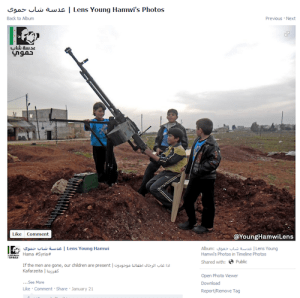
After the death of his mother and his father’s disappearance 5 years ago, Shaaban Abdullah Hamid, aged 12 years, spent several years in the streets or doing casual jobs at a plastic factory. An uncle of Shaaban presented the boy with a handgun and offering him a job as a soldier for the Islamist group Afhad al-Rasul. The training lasted one month, after which the boy spent the following two months sniping at people walking or driving on an Aleppo bridge. Killing a civilian brought him $2.5, and killing a government soldier, $5. Working an 8-hour shift, he killed a total of 13 civilians and 10 soldiers. His firing position stayed warm round the clock, because two other boys worked the remaining two shifts. Shaaban also executed delinquent or offending rebels several times, doing so on orders from his uncle. In the end, his father got word of him and took him to a Red Crescent refugee camp in Hama. From there, both moved to Tartus to take up farming jobs. Asked about any emotions in connection with his sniping, he said he had none. [ii] Continue reading
A Critical Review of Security Council Resolution 1593 (2005) on Darfur
Written by: Ammar Mahmoud. Ammar Mohamed Mahmoud is a First Secretary in the Embassy of the Republic of the Sudan in Abuja, Nigeria. Prior to his current position, Mr. Mahmoud had been serving in the Department of International Law and Treaties at the Ministry of Foreign Affairs of Sudan.
As Sudan is not a party to Rome Statute[1], the Security Council used Resolution 1593, which adopted under Chapter VII of the Charter on March 31, 2005, to trigger ICC jurisdiction in Darfur stating that Continue reading
Kenyatta Decision: A Case of Double Standards?
“Mr. Kenyatta is excused from continuous presence at other times during the trial. This excusal is strictly for purposes of accommodating the discharge of his duties as the President of Kenya”. With these words the ICC trial Chamber in the case The Prosecutor v Uhuru Muigai Kenyatta made one of the most significant decisions regarding the trial of senior state officers. The court was faced with an unprecedented situation: the leader of a country is, for the first time, due to stand trial before an international tribunal on charges of having committed war crimes. Continue reading