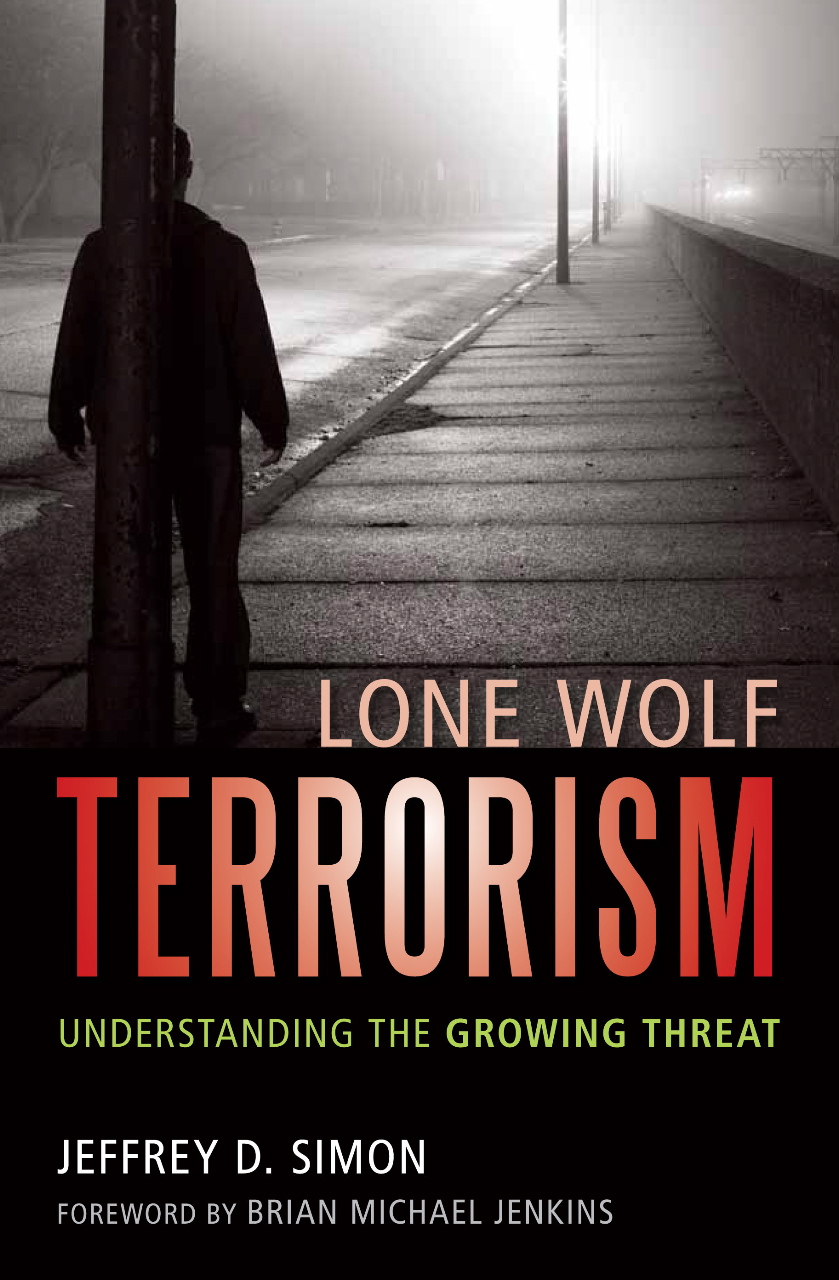
Lone Wolf Terrorism

Cover Lone Wolf Terrorism

 JEFFREY D. SIMON, Ph.D.

When the Irish Republican Army failed in an attempt to assassinate British Prime Minister Margaret Thatcher in 1984, the terrorist group issued the following chilling statement: “Today we were unlucky, but remember, we only have to be lucky once.  You will have to be lucky always.”  In those brief words, the IRA got to the heart of the problem of combating terrorism.  No government or society can realistically expect to always be “lucky” against terrorists since the targets of terrorists are limitless and their strategies and tactics are always evolving.

And that is where the lone wolf terrorist comes into play.  As difficult as it is to try to prevent terrorist groups and cells from perpetrating a major attack, it is even more difficult to prevent a lone wolf from doing so.  In my new book, Lone Wolf Terrorism: Understanding the Growing Threat, I try to unravel some of the unique aspects of the lone wolf threat and outline some steps that can be taken to try to reduce the risk of attacks.

I first became interested in lone wolf terrorism when I conducted a case study of an individual (Muharem Kurbegovic) who had terrorized Los Angeles in the 1970s.  Known as the “Alphabet Bomber” he single-handedly brought the city to a standstill and caused widespread fear by his actions and threats, which included a deadly bombing at Los Angeles International Airport and threats to unleash nerve gas over populated areas.  It was then that I realized that the lone wolf could be a powerful actor in the world of terrorism.  In fact, lone wolves have proven to be as dangerous, and have as much of an impact upon governments and societies as the better-trained and organized terrorist groups and cells.

Recent years have witnessed several major attacks by individual terrorists, ranging from Anders Breivik’s massacre of scores of youths on an island in Norway shortly after setting off a bomb in Oslo to Maj. Nidal Malik Hasan who is accused of killing thirteen fellow soldiers and others at Fort Hood, Texas.  The fact that Breivik is an anti-Islamic extremist and Hasan is an Islamic extremist, underscores the diversity in the growing lone wolf terrorist threat.  Lone wolves come from all parts of the political and religious spectrum.  There have also been terrorist incidents and plots by neo-Nazis, white Supremacists, and “single-issue” extremists.

One of the factors that distinguish lone wolf terrorists from those who are members of a group or cell is their freedom to act upon any scenario they might think up.  There is no group decision-making process or group pressure to stifle creativity.  This has resulted in some of the most innovative terrorist attacks in history.  For example, lone wolves were responsible for the first vehicle bombing (1920), major midair plane bombing (1955), hijacking (1961), product tampering (1982) and anthrax letters attack (2001) in the United States.  Lone wolves think outside the box, which is an advantage in trying to come up with new ideas for terrorist attacks.

Lone wolves are also dangerous because the have little or no constraints on their level of violence.  They are not concerned with alienating supporters (as would many terrorist groups) nor are they concerned with a potential government crackdown following an attack.  That is why they are potential candidates to use weapons of mass destruction (WMD).  There has already been a bioterrorist attack (the anthrax letters) committed by a lone wolf in the U.S.  Lone wolves have no supporters or financial and political backers who might be alienated by a WMD attack and no headquarters or training camps that could be hit in retaliatory raids.  A lone wolf might also believe that committing a conventional terrorist attack similar to those occurring regularly around the world would not yield as much publicity and notoriety as an attack with a chemical, biological, or nuclear weapon.

Lone wolves are also more difficult to identify and capture since they work alone.  There are usually no communications to intercept or members of a group to arrest and learn about potential plots.  They can also sometimes by mentally unstable, yet still very effective, such as Theodore Kaczynski, the infamous Unabomber, who sent package bombs throughout the United States from 1978 to 1995.

Although lone wolves have been active in the past, we are witnessing a new wave of attacks due to the revolutionary impact of the Internet.  The Internet is at the center of what I label as the Technological Wave of terrorism.  Technology is there for all to take advantage of, including lone wolves.  If the Internet did not exist, lone wolves would probably have had to invent it.  They use the Internet for a variety of purposes.  This includes conducting online research for targets, tactics and weapons; becoming self-radicalized by visiting terrorist websites and/or engaging in extremist chat rooms; and posting blogs and manifestos online, sometimes announcing to the world what they intended to do.  For example, Anders Breivik, the Norwegian lone wolf, posted a 1500-page manifesto shortly before his attack where he extolled the virtues of killing large numbers of people for maximum publicity.  In another case, an American woman, Coleen LaRose, who identified herself as “Jihad Jane” in her online postings, used the Internet in an attempt to form her own terrorist network.

It is this desire to communicate through the Internet that provides one of the best opportunities to identify potential lone wolves before they strike.  Through the monitoring of the Internet (without violating law abiding individuals’ civil liberties) much can be learned about who the lone wolves are.  This includes the identification of individuals who, as noted above, are visiting extremist chat rooms, purchasing bomb making materials and other suspicious items online, or posting threatening blogs or manifestos.  Additional strategies that may prove helpful in preventing lone wolf attacks are the expansion closed circuit television (CCTV) cameras in public settings, improved detection devices in post offices and other facilities to identify package bombs or letters containing anthrax spores, and further advances in biometrics, including the use of gait analysis which assesses how somebody is walking to determine if a person may be carrying a bomb or other weapon.  Increased public awareness is another important strategy, such as the reporting of unattended packages in airports, bus terminals, shopping malls, and other potential targets for a terrorist attack.

The lone wolf is forcing us to rethink some of our basic concepts about terrorism.  No longer can we view terrorism as emanating solely from organized or decentralized groups and cells.  The lone wolf has proven to be a formidable foe in the battle against terrorism.  This is likely to continue in the years ahead.


Jeffrey D. Simon is an internationally recognized author, lecturer, and consultant on terrorism and political violence. He is president of Political Risk Assessment Company., Inc., and a visiting lecturer in the Department of Political Science at UCLA.  His most recent book, Lone Wolf Terrorism: Understanding the Growing Threat, was published in 2013(http://www.prometheusbooks.com/index.php?main_page=product_info&cPath=57_66&products_id=2155).  A former RAND analyst, Dr. Simon has conducted research and analysis on terrorism for more than twenty-five years.  His writings on terrorism, political violence, and political risk have appeared in many publications, including the Journal of the American Medical Association, Foreign Policy, and the New York Times.  His website can be found at www.futureterrorism.com.

Between Welfare And Warfare: The Two-Faced Character Of Hamas

WRITTEN BY: CAMILLA GIOVANNINI

The article aims to point out the double nature, as welfare agency and, at the same time, as armed group, of Hamas, leaving apart the theoretical issue concerning the definition of terrorism and focusing on the implications that this ambivalence implies from an international perspective, specially connected to the blacklisting.


Hamas, the acronym of Harakat al Muqāwama al Islāmiyya (Islamic Resistance Movement), was established in Gaza in 1987 as the Palestinian branch of the Muslim Brotherhood[1]. This latter was founded by the schoolteacher Hasan al Banna in Egypt in 1928. At the beginning it was a trade union for Arab and Egyptian workers employed in constructing the Suez Channel. It aimed to promote a culture of solidarity from an Islamic perspective. Ten years after its foundation the organization could count 500.000 members, belonging primarily to the poorest levels of the society. Recalling the traditional Islamic values the league promoted a political view of Islam, also through the opening of  “islamized places”, where relations were involved just among Muslims, without any western contamination. In order to achieve its goals it rooted in the mosques through the means of preaching, da’wa, and was very active in the social services and welfare system. Its presence in the educational and social agencies has been a feature still today, verifiable within the Brotherhood and its affiliate organizations, among them, precisely, Hamas.

As its parental organization, Hamas’ attention and commitment towards the people is a distinctive character which connotes its action and, at this regard, article 21 of the Covenant of Hamas states: “Mutual social responsibility means extending assistance, financial or moral, to all those who are in need and joining in the execution of some of the work. Members of the Islamic Resistance Movement should consider the interests of the masses as their own personal interests”.

The Covenant helps also to figure out the movement’s goals and ideology. Article 1 concerns Islam, perceived as origin and source of interpretation: “The Movement’s programme is Islam. From it, it draws its ideas, ways of thinking and understanding of the universe, life and man. It resorts to it for judgment in all its conduct, and it is inspired by it for guidance of its steps”. From the religion springs the awareness about the conditions of the Palestinian people and the decision to fight: “The basic structure of the Islamic Resistance Movement consists of Moslems who have given their allegiance to Allah whom they truly worship, – “I have created the jinn and humans only for the purpose of worshipping” – who know their duty towards themselves, their families and country. In all that, they fear Allah and raise the banner of Jihad in the face of the oppressors, so that they would rid the land and the people of their uncleanliness, vileness and evils[2].

With regard to Israel and its existence, the statute is clear: “Moreover, if the links have been distant from each other and if obstacles, placed by those who are the lackeys of Zionism in the way of the fighters obstructed the continuation of the struggle, the Islamic Resistance Movement aspires to the realization of Allah’s promise, no matter how long that should take. The Prophet, Allah bless him and grant him salvation, has said:

“The Day of Judgment will not come about until Moslems fight the Jews, when the Jew will hide behind stones and trees. The stones and trees will say O Moslems, O Abdulla, there is a Jew behind me, come and kill him. Only the Gharkad tree would not do that because it is one of the trees of the Jews.” [3]. The goal of Hamas is to eliminate the State of Israel and to replace it with an Islamist State in all of what was once the land covered by the British mandate, since Palestine is a waqf, an holy endowment, which has to be Islamic[4]. Accordingly, in 2006, when the organization won the political election in Gaza, it imposed in the Strip a strict observation of sharī‘a.

The slogan of Hamas, at article 8, is an effective summary of the organization’s belief: “Allāh is its target, the Prophet is its model, the Qur’an its constitution: jihād is its path and death for the sake of Allāh is the loftiest of its wishes”.

In order to achieve its aims, Hamas is committed in social welfare activities: the organization’s annual budget is estimated in 70 million dollars[5] and the substantial part of it, the 75-80%[6], is devoted to the social services network, which has ensured that support to the organization, which led this latter to the electoral victory. Moreover, it is engaged in political activity and in guerilla and terrorist attacks against Israeli soldiers and civilians. The political wing has always had the control on the entire organization, hence also on the military component: the ‘Izz al Dīn al Qassām Brigades, for which it buys weapons and raises funds. The military wing, in turn, takes part to the decision making process even with regard to the political issues[7].

Starting from 1988, Hamas has begun to act, for first just in the Gaza Strip, then also in Judea and Samaria, targeting villages and towns and taking hostages. There has never been any distinction between soldiers and civilians because: “Every Jew or settler is a target and must be killed. Their blood and their property are forfeit[8]. In Mehola (Israel), April 16, 1993, Hamas opened the season of the suicide terrorism with a car bomb, bringing in the Israeli cities the same dynamics that, ten years before, Hizballāh used in Lebanon. This deadly campaign, which increased in the ‘90s and during the so-called “second intifada”, was responsible for the 40% of all the attacks and caused the 44% of the victims of terrorism in Israel[9].

Hamas’ social services, made of mosques, hospitals, orphanages, schools, religious societies, associations and sport teams, attract funding from abroad, through charitable societies and benefactor States, among them, for instance, Iran, as it was proven once again[10] during the last war in Gaza in the end of 2012, and Syria which also hosted the organization’s foreign contingent, also known as the external leadership, until November 2012. This latter has been in charge of keeping relations with the third Countries: Yemen as well as Iran. Syrian support was granted to Hamas by Hāfiz Assad and then by his son Bashār. The Country is a communication route with Iran, crossed by persons, goods and weapons, and a hosting territory for training camps[11].

Through the Islamic duty of zakāt, charities controlled by Hamas, for instance the Union of Good[12], collect a huge flow of money, especially from Saudi Arabia[13]. However, the Kingdom has been undertaking some agreements with Israel, since the support to the Palestinian cause should be seen from a wider perspective, inserted in the Middle-east chessboard, which implies the struggle for the control on the Region. Thus, from 2001, the flow of funds from Saudi Arabia to Hamas has been progressively reduced in a way inversely proportional to the increasing Iranian funds[14].

In 2003 the European Union listed Hamas in its terror blacklist, replacing the ‘Izz al Dīn al Qassām Brigades (in the list since 2001), opting for an unified consideration of the organization. The European awareness to be dealing with an unique, even articulated, movement has been the result of a different approach, antithetic to the previous one, which was used to split the military from the political wing. National authorities do not always confirm the Community decision: the United Kingdom has blacklisted just the Brigades, due to the consideration towards the organization’s social activities; furthermore, France keeps open channels and relations with it[15]. Outside the Union, Australia and New Zealand have taken the same decision of the Great Britain, on the contrary, United States and Canada have blacklisted the entire organization. In 2006 the Russian newspaper Rossiiskaya gazeta published the list of the terrorist groups drawn up by the Supreme Court of the Russian Federation. According to the words of the general Yuri Sapunov, at that time head of the antiterrorism at the Federal Security Service, the absence, in the list, of Hamas and of the Brigades was justified by the unclearness, on the international scene, about the nature of the organization. Moreover Hamas, and the Brigades as well, did not represent a threat to the Russian security, since they were not linked to the groups operating in Caucasus[16].

With regard to Hamas, as we have seen, the European Union reached the unanimity required by the Council Regulation 2580/2001 in order to list Hamas and to impose on it the provided restrictive measures. On the contrary, this consensus has always been missing when Hizballāh is at stake. Although also recently, after the suicide bombing of a bus full of Israeli tourists in the Bulgarian city of Burgas, Germany[17], United Kingdom and Netherland[18] have called for banning the Lebanese group, the European Governments are not able to find a common position about. Within the Union, just Netherland and Germany have banned Hizballāh, while Great Britain blacklisted only its military wing.

This disagreement is caused by organization’s relevance as social agency in Lebanon. As well as Hamas, the movement since its origin has been committed in providing assistance and services to the Lebanese Shi’ite community, hospitals, schools, summer camps, and creating job positions for the people from the southern quarters of Beirut and the Bekaa Valley.  However these agencies are also finalized to the recruitment of new members for joining the group. Hizballāh uses its summer camps to indoctrinate youngsters with its ideology, celebrating the terrorist culture, teaching to hate Israel, feeding the cult for Hassan Nasrallah’s personality and glorifying the organization’s martyrs[19].

Hamas services too are basins of votes and laborers: the funds are used for financing the social agencies, helping the poorest but also for buying weapons and for sustaining the families of those who were killed or imprisoned during the operations against Israel. Schools and summer camps for children and kids, which host 100.000 minors every year, are places aimed also to indoctrinate the young generations, training them to the hate for Israel, to the military techniques and to the charm of the martyrdom. The following example is a grammar exercise taken from a schoolbook provided by Hamas: “Believers who sit at home, other than those who are disabled, are not equal with those who strive and fight in the cause of Allah with their wealth and their lives[20].

The European Union, with regard to Hamas, has been able, so far, to perceive that the organization is one, now it is at a crossroads: it is called to decide if it wants to apply the same interpretation to the national blacklisting processes and to Hizballāh or if it wants to make a step back and to remove from the list Hamas’ political wing, keeping it as speaker and including its leadership in the peace deals.


[1] Article 2, The Covenant of the Islamic Resistance Movement, 1988

[2] Ivi, article 3

[3] Ivi, article 7

[4] Ivi, article 11

[5] Jonathan Masters, Hamas, Council on Foreign Relations, last update 27 November 2012, available at the website http://www.cfr.org/israel/hamas/p8968 (last visit 21 February 2013)

[6] David H. Gray, John B. Larson, Grass roots terrorism: how Hamas’s structure defines a policy of counterterrorism, Research Journal of International Studies – Issue 8 (November, 2008), p. 126

[7] Intelligence and Terrorism Information Center, Hamas and the terrorist threat from the Gaza Strip, March 2010

[8] Hamas leaflet 65/1990. Source: Boaz Ganor, Hamas – the Islamic resistance movement in the Territories, International Institute for Counter Terrorism

[9] Intelligence and Terrorism Information Center, Profile of the Hamas movement, February 2006

[10] Saeed K. Dehghan, “Iran supplied Hamas with Fajr-5 missile technology”, The Guardian, 21 November 2012, available at the website http://www.guardian.co.uk/world/2012/nov/21/iran-supplied-hamas-missile-technology (last visit 6 March 2013). Iranian support to Hamas has been ensured also through Hizballāh, which has provided its infrastructures to Iranian instructors training Hamas’ members

[11] See supra, note 9

[12] Office of the Coordinator for Counterterrorism, Country Reports on Terrorism 2011, U.S. Department of State, available at the website http://www.state.gov/j/ct/rls/crt/2011/195553.htm#hamas (last visit 8 March 2013)

[13] David H. Gray, John B. Larson, see supra note 6, p. 129

[14] See the U.S. Patterns of Global Terrorism, from 2001 on.

[15] Steven Erlanger, “France admits contacts with Hamas”, in The New York Times, 20 May 2008, available at the website http://www.nytimes.com/2008/05/20/world/europe/20france.html (last visit 8 March 2013)

[16]  Robert Parsons, “Russia: Supreme Court approves List of 17 terrorist groups”, in Radio free Europe. Radio liberty, 28 July 2006, available at the web site http://www.rferl.org/content/article/1070179.html (last visit 8 March 2013)

[17] Benjamin Weinthal, “Top German politician calls for EU to ban Hezbollah”, The Jerusalem Post, 23 August 2012, available at the website http://www.jpost.com/International/Article.aspx?id=282357 (last visit 8 March 2013)

[18] News agencies, “UK seeks to add Hezbollah to EU’s terror watch list”, Ynetnews, 7 September 2012, available at the website http://www.ynetnews.com/articles/0,7340,L-4278524,00.html (last visit 8 March 2013)

[19] Intelligence and Terrorism Information Center,

http://www.terrorism-info.org.il/data/pdf/PDF_08_220_2.pdf (last visit 8 March 2013)

[20] Itamar Marcus, “From nationalist battle to religious conflict: New 12th grade Palestinian schoolbooks present a world without Israel”, Palestinian Media Watch, February 2007, available at the website http://www.palwatch.org/STORAGE/special%20reports/SchoolBooks_English_Final_for_web.pdf (last visit 8 March 2013)

Accountability for Torture by United States Since 9/11

WRITTEN BY: JAMES ROTH

James Roth is a retired lawyer, now a writer. He was one of the founders and long-time board member of Advocates For Human Rights and The Center For Victims of Torture.  He is currently completing his first novel entitled “Beyond Torture.” He is also active with many groups working on foreign policy and international human rights issues.

Summary:

Before 9/11 it was widely accepted that torture was illegal under international and United States domestic law. The United States had signed and ratified the Convention Against Torture and had enacted the anti-torture statute of 1994, 18 U.S.C. Sections 2340-2340A , which criminalized acts of torture by United State nationals or non-nationals committed outside the United States, as well as the Torture Victim Protection Act of 1991.

Shortly after 9/11 Bush administration officials sought and received authorization through various legal memos and reports by the Department of Justice and Department of Defense to create detention facilities outside the United States and to use harsher interrogation techniques than those previously approved. The result was the use of “Enhanced Interrogation Techniques” as well as increased renditions of detainees to other countries for interrogation.

Many abuses which have now been well-documented followed including long-term detentions without access to legal counsel or legal oversight, widespread use of interrogation techniques broadly acknowledged as being torture and cruel and unusual punishment, including deaths of over 100 detainees under questionable circumstances.

Upon taking office in January 2009, President Obama issued Executive Order 13491—Ensuring Lawful Interrogations. Yet, despite well-documented violations of international and domestic laws no clear standards have emerged and there has been no accountability except for a handful of lower level military personnel.

This article outlines a number of areas, both legislative and domestic, that it urges our Congressional Representatives and Senators to pursue.

Specifically, this article urges action to confront the United States Congress to:

  1. Release to the public the December 2012 Senate Intelligence Committee Report with as few redactions as possible so that the public can understand what brought about the shift in U.S. policy toward torture and cruel treatment and diminished America’s longstanding consensus against torture and cruel treatment.
  2. Request that President Obama release in some form the report(s) by the Special Interagency Task Force on Interrogation and Transfer Policies established under Executive Order 13491.
  3. Issue an apology to Canadian citizen Mahar Arar, who was mistakenly retained and rendered to Syria where he was tortured, and to Khalid El-Masri, a Lebanese-Canadian who was kidnapped by the CIA in Macedonia where he was tortured and then flown to Afghanistan and tortured some more until the CIA discovered that it had the wrong person and dumped him on an isolated street in Albania.
  4. Ask the Office of the Inspector General for the CIA to supplement the 2004 Report in light of recently obtained information contained in a Human Rights Watch Report of alleged waterboarding and other abuses of detainees in Libya.
  5. Ask Attorney General Holder to investigate the alleged abuses in Libya.
  6. Take appropriate action to encourage local communities to accept detainees from Guantanamo who have been exonerated.
  7. Assure that appropriate oversight is established and maintained so that torture and cruel treatment does not occur in the future.

Background

On September 14, 2001 President Bush issued the “Declaration of National Emergency by reason of Certain Terrorist Attacks.”[1] On September 17, 2001 President Bush issued a 12-page directive (known as a “memorandum of notifications) to the Director of the CIA and members of the National Security Council authorizing the CIA to capture suspected terrorists and members of Al-Qaeda and to create detention facilities outside the United States to hold and interrogate them.[2]  The International Committee of the Red Cross was refused access to detainees held in the new CIA program until September 2006.[3] On November 13, 2001 President Bush authorized the detention of alleged terrorists and subsequent trial by military commission, which he ordered would not be subject to the principles of law and rules of evidence applicable to U.S. federal courts.[4]

On July 11, 2002, the first detainees arrived in Guantanamo Bay, Cuba. On January 18, 2002 President Bush declared that the Third Geneva Conventions did not apply to the conflict with Al Qaeda or the Taliban and that they would not receive the protections afforded to prisoners of war.[5] On February 7, 2002 President Bush issued a memorandum to that effect.[6] In so doing, the President rejected the requests by Secretary of State Colin Powell to reconsider and reverse his decisions,[7] as well as the advice of William H. Taft, IV, Legal Adviser to the State Department, that these decisions were inconsistent with the plain language of the Geneva Conventions and contravened the unvaried interpretation and practice in the fifty years since the United States became a party of the Conventions.[8]

In March 2002, the first “high value detainee”, Abu Zubaydah, was detained and interrogated by the CIA.[9]  The CIA interrogation program sanctioned by President Bush included interrogation techniques adapted from the Survival Evasion Resistance Escape (“SERE”) training program in which U.S. military members were exposed to and taught to resist interrogation techniques used by countries that did not adhere to the Geneva Conventions.[10] As reported in the later CIA Inspector General Report, the U.S. now employed these techniques itself, including waterboarding, confining detainees in a dark box with insects, up to 11 days of sleep deprivation, facial holds and slaps, “walling” (pushing a detainee against a wall) and use of stress positions.[11]

On November 27, 2002 William J. Haynes, General Counsel for the Department of Defense, provided to Donald Rumsfeld an “Action Memo regarding Counter-Resistance Techniques seeking approval of three categories of counter-resistance techniques to aid in the interrogation of detainees at Guantanamo Bay.” Rumsfeld initialed his approval on December 2, 2002 to the first two categories and one of the techniques from the third category (“mild non-injurious physical contact”). This signaled approval of the SERE enhanced interrogation techniques by the military in addition to the CIA. This is one example of the migration of lists and interrogation techniques beyond those approved by the Army Field Manual. U.S. Army General Geoffrey D. Miller was given command of Joint Task Force Guantánamo in November 2002. He implemented the new harsh techniques there. In August 2003 Miller was sent to Iraq by the Department of Defense to help get more information out of Iraqi prisoners. In September Miller submitted a report recommending “GTMO-ising” interrogation techniques–combining the detention and interrogation units at Abu Ghraib into the Theater Joint Interrogation and Detention Center. Miller recommended that prison guards be used to “soften up” prisoners for interrogations.

In September 2003 Lieut. General Ricardo S Sanchez sent a secret cable to US Central Command outlining more aggressive interrogation methods that he planned to authorize immediately, including several that were later revealed when the Abu Ghraib scandal broke.

All of the above facts illustrate how the US military’s ad hoc decision-making created confusion and allowed the harsh methods to infiltrate from Afghanistan to Guantánamo and Iraq. A clear line exists from the initial decision that the Geneva Conventions did not apply to Al Qaeda and Taliban detainees.

As described by the ICRC after they were finally provided with access to detainees, the CIA detention program “included transfers of detainees to multiple locations, maintenance in continuous solitary confinement, incommunicado detention throughout the entire period of their undisclosed detention, and the infliction of further ill-treatment through the use of various methods either individually or in combination, in addition to the deprivation of other basic material requirements.”[12] The ICRC Report further found: “The ability of the detaining authority to transfer persons over apparently significant distances to secret locations in foreign countries actually increased the detainees’ feelings of futility and helplessness, making them more vulnerable to the methods of ill-treatment… these transfers increased the vulnerability… to their interrogation, and was performed in a manner (goggles, earmuffs, use of diapers, strapped to stretchers, sometimes rough handling) that was intrusive and humiliating…”[13]

The United Nations Joint Study on secret detentions found that the CIA had taken detainees who were held in Afghanistan, Thailand, Poland, Romania and other locations. [14]The UN Joint Study further found the CIA “had taken 94 detainees into custody and had employed enhanced interrogation techniques to varying degrees in the interrogation of 28 of those detainees.”[15]

It has been documented that over 100 detainees died while in US custody, many under suspicious circumstances. [16]

The interrogation techniques used on detainees were euphemistically described as “enhanced interrogation techniques” by the US government, but the United Nations and the International Committee of the Red Cross found that they rose to the level of torture and cruel, inhuman and degrading treatment. [17]

Alberto J. Mora served as General Counsel to the U.S. Navy from 2001 to 2006. Upon learning of the authorization of the use of coercive interrogation techniques by the US he stated:

“To my mind, there’s no practical distinction [between cruelty and torture]. If          cruelty is no longer declared unlawful but instead is applied as a matter of policy, it alters the fundamental relationship of man to government. It destroys the whole notion of individual rights. The Constitution recognizes that man has an inherent right, not bestowed by the state or laws, to personal dignity, including the right to be free of cruelty. It applies to all human beings, not just in America—even those designated as ‘unlawful enemy combatants.’ If you make an exception the whole Constitution crumbles.

Besides, my mother would have killed me if I hadn’t spoken up. No Hungarian after communism, or Cuban after Castro, is not aware that human rights are incompatible with cruelty. The debate here isn’t only how to protect the country. It’s how to protect our values.”

On June 22, 2009 Pres. Barack Obama signed Executive Order 13491–Ensuring Lawful Interrogations. In section 3(b) it provided:

Effective immediately, an individual in the custody or under the effective control of an officer, employee, or other agent of the United States government, or detained within a facility owned, operated or controlled by a department or agency of the United States, in any armed conflict, shall not be subjected to any interrogation technique or approach, or any treatment related to interrogation that is not authorized by Army Field Manual 2 22.3.

In section 4(a) the order provided “ The CIA shall close as expeditiously as possible any detention facilities that it currently operates and shall not operate any such detention facility in the future.”

The Order also created a special interagency task force on interrogation and transfer policies. The task force was told to provide a report to the president within 180 days unless an extension was necessary.

The Order required the CIA to use only 19 interrogation methods outlined in the United States Army Field manual on interrogations “unless the Atty. Gen. with appropriate consultation provides further guidance.”

It is unknown whether extraordinary renditions have been carried out since 2009.

Addendum A

Mahar Arar

Mahar Arar is a Canadian citizen who emigrated with his family from Syria at age 17. On September 26, 2002 he was detained by U.S. officials at JFK Airport in New York and interrogated about alleged links to al-Qaeda. Twelve days later he was chained, shackled and flown to Syria where he was held in a tiny “grave-like” cell for over then months. He was beaten, tortured and forced to make a false confession.

His wife, Mosia Mazigh, learned of his imprisonment and campaigned for his release. He was returned to Canada in October 2003. On January 24, 2004 the Canadian government established a Commission of Inquiry to review his treatment by Canadian officials. On September 18, 2006 the Commission of Inquiry cleared Arar of all charges stating “categorically there is no evidence to indicate that Mr. Arar has committed any offense or that his activities constitute a threat to the security of Canada.”

The government of Canada settled the case out of court and paid Arar $10.5 million (Canadian) and Prime Minister Stephen Harper formally apologized to Arar.

In contrast, in 2004 Arar brought a lawsuit in the U.S. in federal court in New York against John Ashcroft and others. The U.S. invoked the “state secrets privilege” and moved to dismiss the lawsuit. It was dismissed and upheld on appeal. Upon rehearing the Chief Judge of the Second Circuit Court of Appeals wrote, “If a civil remedy in damages is to be created for the harms suffered in the context of extraordinary renditions, it must be created by Congress…”

The U.S. Supreme Court declined to accept review of the case.  The U.S. government has taken no steps to make amends to Mr. Arar and his family.

Khalid El-Masri

In a recent landmark decision, the European Court of Human Rights unanimously ruled in favor of Mr. El-Masri on December 12, 2012, corroborating details of his abduction and torture by the CIA and holding that the CIA’s treatment of Mr. El-Masri was torture.

Mr. El-Masri is a Lebanese-Canadian who was kidnapped by the CIA is Macedonia. With the assistance of the Macedonian government he was held incommunicado, severely beaten, sodomized, shackled and hooded, submitted to total sensory deprivation and harshly interrogated for over three weeks. He was then flown to Afghanistan where he was incarcerated in a small, dirty dark brick factory and beaten, kicked, threatened and interrogated for more than four months. When the CIA ultimately learned that he was the wrong person he was dumped on an isolated street in Albania.

In contrast, when Mr. El-Masri brought a case in the U.S. it was dismissed and upheld on national security grounds, as in Mr. Arar’s case, and again the U.S. Supreme Court refused to accept review of his case.

United Nations Special Rapporteur on Human Rights and Counter-Terrorism Ben Emmerson described the European Court of Human Rights ruling as “a key milestone in the long struggle to secure public accountability of public officials implicated in human rights violations committed by the Bush administration CIA in its policy of secret detention, rendition and torture.” He said that the U.S. government must issue an apology for its “central role in the web of systematic crimes and human rights violations by the Bush-era CIA, and to pay voluntary compensation to Mr. El-Masri.”

To date the U.S. government has not responded.


[2] The directive has not yet been publicly released. But see George Tenet, at the Center of the Storm: the CIA During America’s Time of Crisis 208  (Harper 2007).

[3]  ICRC, Report to John Rizzo, Acting General Counsel, CIA. ICRC Report on the Treatment of Fourteen “High Value Detainees” in CIA Custody, 14 February 2007, available at http://www.nybooks.com/doc/2010/04/22/icrc-report.pdf

[4] Military Order of November 13, 2001:Detention, Treatment and Trial of Certain Non-Citizens in the War Against Terrorism, Federal Register, Vol. 66, No.2, 16 November 2001, pp. 57831-36

[5] John Yoo and Robert Delahunty, Memorandum for William J. Haynes, II, General Counsel, Department of Defense, January 9, 2002.

[6] George Bush, The White House, Memorandum for the Vice President, et al, Harsh Treatment of Taliban and al-Qaeda detainees (7 February 2002).

[7] Alberto R. Gonzalez, Memorandum for the President, Decision re Application of the Geneva Conventions to Prisoners of War to the Conflict with Al Qaeda and the Taliban (25 January 2002).

[8] William H. Taft, IV, Legal Adviser, Department of State, Memorandum to Counsel to the President, Alberto Gonzalez, Comments on Your Paper on the Geneva Conventions (2 February 2002).

[9] CIA Inspector General’s Special Review: Counterterrorism, Detention, and Interrogation Activities, September 2001-October 2003, dated 7 may 2004 and publicly released on 24 August 2009, at 12 “CIA IG Report”).

[10] CIA IG Report at 21-22, fn. 26 and 37.

[11] A list of techniques is found in the CIA IG Report at 15.

[12] ICRC CIA Detainee Report at 4.

[13] ICRC CIA Detainee Report at 7. It is notable that the ICRC Report details the same interrogation techniques outlined in the CIA IG Report, which was not publicly available at the time.

[14] 14.       United Nations Human Rights Council, Joint Study on Global Practices in Relation to Secret Detention in the Context of Countering Terrorism of the Special Rapporteur on the promotion and protection of human rights and fundamental freedoms while countering terrorism, the Special Rapporteur on torture and other cruel, inhuman or degrading treatment or punishment, the working group on arbitrary detention, and the Working Group on Enforced or Involuntary Disappearances, A/HRC/13/42, 19 February 2010, at 45-50 (“UN Joint Study”).

[15] UN Joint Study at para. 103.

[16] Testimony of Lawrence Wilkerson, Chief of Staff to Colin Powell U.S. Secretary of State, 2001-2005, before U.S. House of Representatives Judiciary Subcommittee on Civil Rights, June 18, 2008

[17] ICRC CIA Detainee Report, at 5, UN Joint Study at 45-50.

Cyber Warfare: Between Games and Reality

Written by Lina Laurinaviciute

Cyber Warfare: Between Games and Reality
fog-of-cyber-warfare_1Setting the background

A top secret super-computer which has a complete control over a nuclear arsenal and the countdown to World War 3 – such scenarios, as the one of a movie “War Games” (1983) were presented as the science fiction in the last century. Indeed, new expansions in the tactical as well as technical dimensions have changed the landscape of warfare where a cyber space battlefield became a realization of that fictional future.

Today, cyberspace exists in all critical infrastructure sectors: telecommunications networks, the electric grid, power plants, traffic control centers, financial sectors, etc. The same technology that enables us to have live video chat on our mobile phones or remote controls used to control air conditioning units also makes it possible to turn off the lights in a city on the other side of the globe.[1]

Usually, media as well as policy-makers refer to cyberspace when simply looking for a synonym to the Internet or describing anything electronic. However, cyberspace may be described as “a global domain within the information environment consisting of the interdependent network of information technology infrastructures, including the Internet, telecommunications networks, computer systems, and embedded processors and controllers.”[2]

Similarly, such terms as “cyber operations”, “cyber attacks”, or ”network attacks” as well as the concept of cyber warfare are used in different contexts and different people appear to mean different things when they refer to them. In general, cyber operations are conducted against or via a computer or a computer system through a data stream. “Such operations can aim to do different things, for instance to infiltrate a computer system and collect, export, destroy, change, or encrypt data or to trigger, alter or otherwise manipulate processes controlled by the infiltrated system.”[3]

One of the main issues raised by “cyber war” is whether a cyber attack can rise to the kind of attack amounting to war. International Humanitarian Law (hereinafter IHL), also referred to as the laws of war, characterizes war as the resort to protracted and intense armed force by two or more parties. Armed conflict is either between States, characterized as international armed conflict, or between States or armed groups operating inside a single State, referred to as non-international armed conflict. The most well-known of the laws are the 1949 Geneva Conventions[4] and 1977 Additional Protocols[5], which present rules for protecting civilians and those hors de combat (wounded, sick and unable to fight soldiers) in land, naval, and air warfare.[6] As it can be expected, due to the development of new technologies, none of the provisions of these laws specifically mention cyber attacks.

Some researchers, such as Joel Brenner, are of the opinion that cyber attacks should not fall under IHL. As cyber warfare is not a kinetic action, it is not an armed attack and thus, IHL does not apply.[7] However, the growing importance of the use of information technology in military activities and its potential to gain military advantage in a more cost effective way, urges to look at it from the IHL perspective and determine the circumstances, under which cyber operations (as opposed to the traditional kinetic military operations) can constitute attacks within the meaning of IHL.

The fact that a new concept of a cyber attack has come into existence after the treaty laws were adopted, does not preclude the applicability of these laws. Article 36 of Additional Protocol I (hereinafter AP I) says that in the study, development or adoption of a new weapon or method of warfare, States Parties are under an obligation to determine whether their employment would, in some or all circumstances, be prohibited by international law applicable to them.[8] Also, in its 1996 Advisory Opinion on the Legality of the Threat or Use of Nuclear Weapons, the International Court of Justice held that “it cannot be concluded […] that the established principles and rules of humanitarian law applicable in armed conflict did not apply to nuclear weapons. Such a conclusion would be incompatible with the intrinsically humanitarian character of the legal principles in question which permeates the entire law of armed conflict and applies to all forms of warfare and to all kinds of weapons, those of the past, those of the present and those of the future”.[9] Hence, it has been well accepted already that “a lack of directly applicable treaty law does not create an international humanitarian law – free zone, where anyone can conduct hostile activities without rules or restraints.”[10] Due to the fundamental prohibitions, IHL was designed to be flexible enough to accommodate technological developments, including those that could never have been anticipated at the time.[11] It follows that cyberspace is not a distinct domain subject to a separate body of law.

In this framework, cyber warfare refers to means and methods of warfare that rely on information technology and are used in the context of an armed conflict. The experts of the recently issued Tallinn Manual on the International Law Applicable to Cyber Warfare (hereinafter Tallinn Manual), defined cyber weapons as “any cyber device, materiel, instrument, mechanism, equipment, or software used, designed, or intended to be used to conduct a cyber attack.”[12] It is also important to keep in mind that IHL is applicable in time of an armed conflict. Therefore, one of the challenges addressing war in cyberspace is to determine whether resort to cyber weapons can constitute an armed attack.

In accordance with Article 49 (1) of AP I “Attacks” means acts of violence against the adversary, whether in offence or in defence.[13] A “cyber attack” is very fact-specific and must be distinct from cyber espionage, which is done by many nations including recent cases of China, Russia, Iran and does not violate traditional interpretations of IHL. Examples of the cyber operations that have been carried out so far, such as a 2007 Israeli cyber-attack on Syria that disabled all Syrian anti-air systems so that the Israeli air-force could bomb a secret Syrian nuclear reactor site undetected or the 2007 attacks on Estonian banks and government websites as well as the 2008 Russian cyber attacks on Georgia during the South Ossetia War, do not appear to have had serious consequences for the civilian population.[14] However, they show that while the critical infrastructure of nations continually becomes more reliant on networks and cyberspace, the possible targets for cyber-attacks greatly increase. Logic bombs and computer viruses can disrupt everything from electric grids and the stock market to nuclear power plants and water treatment facilities. Therefore, potentially catastrophic scenarios, such as collisions between aircraft, the release of poisons from chemical plants, or the disruption of vital infrastructure and services cannot be dismissed. Such attacks would most likely have large scale humanitarian consequences and could result in significant civilian casualties and damages.[15]

Therefore, the situations when cyber activities result in death, injury, or significant destruction would likely be treated as a use of force.”[16] However, the determination of the threshold for the use of force, especially, in cases not involving physical harm, remains problematic. It might depend on the degree of damage that a computer network attack causes –“the greater the damage, the more likely the situation will be viewed as an armed conflict.”[17] The other factors, that may be significant for the classification of cyber operation as a use of force, include: immediacy (the speed with which consequences manifest), directness (the causal relation between a cyber operation and its consequences), invasiveness (the degree to which a cyber operation intrudes into targeted systems), measurability of the effects, military character of the cyber operation, extent of State involvement, and presumptive legality (acts not expressly prohibited by international law).[18]

Generally speaking, cyber operations are not violent in the sense of releasing kinetic energy, unless they qualify as an attack by virtue of their consequences, specifically injury or death of persons, damage or destruction of objects. Therefore, the principle of distinction between military and civilian objectives, prohibition of indiscriminate attacks, requirement to take the necessary precautions and abstain from attacks if civilian damage is likely to be excessive to the value of the military objective to be attacked are also applicable to such attacks and operate in the same way as to the attack which is carried out using traditional weapons.[19] Nevertheless, in practice, IHL faces some significant challenges dealing with cyber warfare.

Challenges applying rules of IHL in cyberspace

The challenges met by the international legal regulation in cyber warfare are due to the fact that cyberspace consists of innumerable computer systems across the world where civilian and military computer networks are highly interconnected.[20] A lot of military infrastructure relies on civilian computers or computer networks. It is estimated that 95 percent of world data and voice traffic is carried over fiber optic cables, providing shared bandwidth services to both public and private sectors. Indeed, the interconnectivity of military and civilian networks are so high that it is questionable whether a military-civilian separation in cyberspace is possible and, thus, if a military objective can accurately be targeted without any damage to the civilian cyber infrastructure. For example, 95 percent of American military communication goes through a civilian infrastructure.[21]

It is important to stress, that IHL prohibits indiscriminate attacks. The principle of distinction, as stipulated in the Article 48 of AP I, requires that parties to a conflict distinguish at all times between civilians and combatants and between civilian objects and military objectives.[22] In accordance with Article 51 (4) of AP I, an indiscriminate attack is defined as one which is either not aimed at a specific military objective or because the effects of an attack on a military objective are uncontrollable and unpredictable.[23] Attacks may only be directed against combatants or military objectives, which in pursuant to the Article 52 (2) [24] AP I are the ones that make an effective contribution to the military actions of the adversary and in the circumstances at the time when they are attacked must give a direct and concrete military advantage to the attacker.

Military objectives, such as communication lines, command and control systems, computers or computer systems used in support of military infrastructure or for military purposes can be targeted. As long as the two conditions that determine a military objective are fulfilled and as long as the attack does not spill over to civilian damage and suffering, the act is legitimate. It follows that attacks via cyber space may not be directed against computer systems used in medical facilities, schools, and other purely civilian installations that has special protections against attacks, such as drinking water installations and irrigation works, dams, dykes, or nuclear electric stations that have the ability to release dangerous forces.[25]

Thus, the uncontrollable computer virus would be prohibited as an indiscriminate weapon in the same way that the use of a biological virus would be prohibited; while a destructive cyber attack that leads to the overheating and destruction of exclusively military cyber installations would raise no particular legal concerns. An obvious example would be the release of a virus or a range of viruses into the computer systems of a target State. Even if introduced only into the military network of a State, if the virus is virulent enough, it would soon seep out of that network and into civilian systems of the targeted State or even beyond to neutral or friendly States. Such viruses must most likely should be considered as indiscriminate because they cannot be directed against a specific military objective, and they would be a mean or a method of combat which effects cannot be limited as required by AP I even if aimed accurately at the intended target.[26]

Also, some dilemmas are raised on the use of social networks for military purposes. Indeed, in recent conflicts, it became a common practice to transmit military information via Twitter, Facebook and other social media. The experts of the Tallinn Manual agreed that such use of social networks would transform those facets of the social media networks that are used for military purposes into military objectives. However, the entire networks would not be subject to direct attack.[27]

Another problematic issue is the status of persons involved in cyber operations.

When activities related to cyber attack are performed directly by the personnel of armed forces, it is considered to be performed by a combatant and, thus, such person can directly be attacked and are subject to have prisoners of war status. The problem is that since the specific technical expertise of computer technology mostly lies in the civilian domain, the use of civilians for military activities can be a common practice. It follows, that civilians who are directly participating in hostilities (hereinafter DPH) can become legitimate targets. The involvement in DPH can be manifested through various forms. For example, civilians may be those who launch a cyber attack or they are used to maintain the computer programs or computer network from which a cyber attack is launched. However, the interpretation of the concept of DPH in activities related to cyber attacks, which results to the loss of protection under IHL, is still debatable.[28]

In addition, it is a fundamental rule of IHL that if a party to an armed conflict intends to carry out a cyber attack it is under a legal obligation to conduct a proportionality assessment and to take precautions before launching such an attack. Respect for these principles, as reflected in Article 57 AP1, includes the obligation of an attacker to take all necessary precautions in the choice of means and methods of attack in order to avoid or minimize civilian casualties and collateral damages. [29]For example, commanders must decide whether launching a worm attack on the network of the adversary is feasible or not because the functioning of a worm is such that it has a very high capability of infecting large networks, and that shows its capability of damaging civilian cyber infrastructure, including that of hospitals and banks.[30] In this view, collateral damage is perceived as the loss of civilian objects during military combat operations due to the violent character of war.

Collateral damage in order to get the direct and concrete military advantage is legal as long as it does not violate the rules of proportionality. According to them “[a] cyber attack that may be expected to cause incidental loss of civilian life, injury to civilians, damage to civilian objects, or a combination thereof, which would be excessive in relation to the concrete and direct military advantage anticipated is prohibited.”[31] Therefore, no collateral damage is acceptable if it is in excess of the anticipated concrete and direct military advantage.

In this regard, the development of new technologies may successfully contribute to the purpose of protection reflected in the core principles of IHL. In certain cases cyber operations might cause fewer incidental civilian casualties and less incidental civilian damage compared to the use of traditional weapons.

However, despite the advantages provided by the new technologies, the digitalization on which cyberspace is built causes another difficulty in applying the rules of IHL to cyberspace, as in most cases, it is difficult if not impossible to identify the author of an attack, the location from which it is being conducted, and to estimate its destructive potential. It is often necessary to work a way back in the chain of computers controlling other computers in order to figure out who attacked. This implies some sort of intrusive capability to identify who is attacking and thus complicates the attribution of conduct.[32]

However, from the general point of view, attribution is a practical/ technical problem in nature and therefore, can be resolved through practical or technical means, but not by means of the law. Hence, the tendencies of technological innovation may provide solutions to this practical difficulty much faster than we may anticipate today.[33] Till that day, the anonymity of communications rise difficulties on the attribution of responsibility to individuals and parties to conflict on which IHL strictly relies.

The experts of Tallinn Manual came to an agreement that “no State may claim sovereignty over cyberspace per se” and that “States may exercise sovereign prerogatives over any cyber infrastructure located on their territory, as well as activities associated with that cyber infrastructure.”[34] However, “the fact that a cyber operation has been routed via the cyber infrastructure located in a State is not sufficient evidence for attributing the operation to that State.”[35] Indeed, the technology for conducting offensive operations in cyberspace can be obtained anywhere, for instance, by mail order, while the knowledge needed to conduct some kind of cyber attack is available on the internet. Thus, many non-state actors, such as companies, terrorists, organized crime, patriotic hackers or even teenagers, can have influence.

In this regard, the International Court of Justice in its very first case on Corfu Channel, held that a State may not “allow knowingly its territory to be used for acts contrary to the rights of other States.”[36] For example, a State would be obligated to take necessary measures to end a cyber attack launched by a terrorist group from its territory against other States.

In addition, According to the Articles on State Responsibility, “[t]he conduct of a person or group of persons shall be considered an act of a State under international law if the person or group of persons is in fact acting on the instructions of, or under the direction or control of, that State in carrying out the conduct.”[37] The jurisprudence of the International Court of Justice suggests that the degree of control for attribution to occur shall reach the level of an “effective control” over non-State actors. Therefore, “merely encouraging or otherwise expressing support for the independent acts of non-State actors does not meet the threshold for the degree of control.”[38]

In this regard, the International Court of Justice in the Nicaragua judgment pointed out that the notion of an armed attack includes “‘the sending by or on behalf of a State of armed bands, groups, irregulars or mercenaries, which carry out acts of armed force against another State of such as to amount to’ (inter alia) an actual armed attack conducted by regular forces, ‘or its substantial involvement therein’.”[39] It follows that, for instance, providing an organized armed group with malware (funding, legal, practical support) to be used against another State would constitute a use of force, while only providing sanctuary to that group would not reach such level.

However, the more complicated question is whether a non-State actor’s cyber operations that are not attributable to a State can nevertheless qualify as an armed attack and thus can justify  as the use of force in self-defense against that non-State actor.

Article 51 of the United Nations Charter stipulates that: “Nothing in the present Charter shall impair the inherent right of individual or collective self-defence if an armed attack occurs against a Member of the United Nations, until the Security Council has taken the measures necessary to maintain international peace and security.” Concerning this issue, the position of the US government, for instance, has long been that “the inherent right of self-defense potentially applies against any illegal use of force. There is no threshold for a use of deadly force to qualify as an ‘armed attack’ that may warrant a forcible response.”[40]

An agreement can be reached that cyber operations resulting in death or serious injures of individuals or serious damage to objects can qualify as armed attacks. As mentioned before, whether a cyber use of force qualifies as an armed attack depends on its scale and effects. However, the defensive actions are also subject to the requirements of IHL (necessity, proportionality, imminency, and immediacy). It follows that, “[a] State that is the target of a cyber operation that rises to the level of an armed attack may exercise its inherent right of self-defense.”[41] Furthermore, “a State need not take the first cyber hit before acting to defend itself”[42] and, thus, by this approach the “anticipatory self-defense” is allowed under international law.

The way forward

The world of new technologies is neither a world of virtual games nor it is a science fiction. Warfare in a cyberspace can cause death and damage to the real world. However, technology, in itself, is neither good nor bad, “it can be a source of good and progress or result in terrible consequences at worst.”[43] Indeed, today, none of the so called natural domains (air, maritime or space) can function if cyberspace fails which would mean going back to the time of the messenger pigeon or a drawing board.[44]

Even though international laws do not specifically mention cyber attacks, cyber warfare is not emerging in a legal hole or creating a new legal crisis. Cyber operations can be treated as a means and methods of warfare and therefore, IHL rules, that set limitations to cyber attacks through the principles of distinction, proportionality and precaution are applicable. However, the above mentioned challenges, for applying the pre-existing legal rules to a new technology, points out certain gray areas that require further analysis to determine whether these rules are sufficient and clear in light of the technology’s unique attributes. Therefore, specific cyber warfare laws or even a comprehensive treaty might be adopted in the future as technologies evolve and their impact becomes better understood.

Indeed, policy makers and military leaders all over the world are considering the implications of cyber warfare and a number of countries have already taken steps to increase their cyber-warfare capabilities, whereas NATO has listed cyber-defense as a major initiative of its new Strategic Concept.[45] However, in a view of the current political environment, where states have varying views on cyber security, most probably the technology will develop faster than laws. Hopefully, it will not only bring new challenges but also will offer effective solutions for the successful application of IHL in cyberspace.


[1] Dr. Priya Dixit, International Humanitarian Law for Cyber-Warfare, Proceedings of The National Conference

On Undergraduate Research (NCUR) 2011, New York, March 31 – April 2 2011, p. 1.

[2] Ibid., p 2.

[3] Cordula Droege, No Legal Vacuum in Cyber Space, ICRC Interview, 16 August 2011, available at: http://www.icrc.org/eng/resources/documents/interview/2011/cyber-warfare-interview-2011-08-16.htm, [accessed 28 February 2013].

[4] IV Geneva Conventions, 1949.

[5] Additional Protocols to the IV Geneva Conventions, 1977.

[6] In International Committee of the Red Cross,War and International Humanitarian Law, 2011.

[7] Joel Brenner, Cyber-Security: Regulating Threats to the Internet under International Law, ASIL Live-Blogging, available at: http://thenewinternationallaw.wordpress.com/2012/03/29/asil-live-blogging-cyber-security-regulating-threats-to-the-internet-under-international-law, [accessed 28 February 2013].

[8] Additional Protocol I, Article 36, 1997.

[9] International Court of Justice, Legality of the Threat or Use of Nuclear Weapons (General List No. 95) (8 July

1996).

[10] Michael N. Schmitt, International Law in Cyberspace: The Koh Speech and Tallinn Manual Juxtaposed, December 2012, p. 5.

[11] International Institute of Humanitarian Law, International Humanitarian Law and New Weapon technologies, 2011, p. 24.

[12] Tallinn Manual on the International Law Applicable to Cyber Warfare, Cambridge University Press 2013, available at: http://www.ccdcoe.org/249.html, [accessed 28 February 2013].

[13] Supra note 8., Article 49 (1).

[14] Supra note 1., p. 6.

[15] Supra note 3.

[16] Supra note 10., p. 7.

[17] Knut Dörmann, Applicability of the Additional Protocols to Computer Network Attacks, p. 3.

[18] Supra note 12.

[19] Supra note 12.

[20] Supra note 17.

[21] Supra note 11., p. 148.

[22] Supra note 8., Article 48.

[23] Ibid., Article 51 (4).

[24] Ibid., Article 52 (2)

[25] Bhaskar Sharma, Cyber War and Jus in Bello, December 2012, available at: http://www.foreignpolicyjournal.com/2012/12/03/cyber-war-and-jus-in-bello, [accessed 28 February 2013].

[26] Supra note 17., p. 5.

[27] Supra note 12.

[28] Supra note 25.

[29] Supra note 8., Article 57.

[30] Supra note 25.

[31] Supra note 10., p. 16.

[32] Supra note 11., p. 142.

[33] Ibid., p. 172.

[34] Supra note 12.

[35] Ibid.

[36] International Court of Justice, Corfu Channel Case (U.K v. Alb.) 1949 I.

[37] Articles of State Responsibility, Article 8.

[38] Supra note 12., p. 23.

[39] International Court of Justice, Military and Paramilitary Activities in and Against Nicaragua (Nicar. v. U.S.), 1986.

[40] Supra note 10.,p. 9.

[41] Supra note 12.

[42] Ibid.

[43] Supra note 11., p. 182.

[44] Ibid., p. 148-152.

[45] NATO, Strategic Concept, 2010, Available at: http://www.nato.int/cps/en/natolive/official_texts_68580.htm#cyber, [accessed 28 February 2013].

Tracing International Humanitarian Law To Hinduism

Picture by Ben Heine

Picture by Ben Heine

Written by Garima Tiwari

India is party to the four Geneva Conventions of 1949 and has incorporated them into its municipal law, but India is not a signatory to the two Additional Protocols. This post examines how far the concepts of Hinduism have helped in the development of international humanitarian law.

War as an art as well as a science was equally well understood in ancient India.[i] The ancient Indians recognized war as a relation between states, the Agnipurana[ii] defines war “as the direct result of the injuries done to each other by two hostile monarchs.” Professor H. H. Wilson calls the ancient Indian laws of war are very chivalrous and humane, and prohibit the slaying of the unarmed, of women, of the old, and of the conquered.[iii]

In ancient times the first and foremost duty of the king was to protect his people. Protection consisted in countering internal threats as well as external aggression to man‟s liberty.[iv] Hinduism has mentioned wars in its various sources. Francois Bugnion has stated of Hinduism having “law of armed forces on the principle of humanity” in the following words,  “The ancient Hindu law of armed conflict, founded on the principle of humanity, had many rules limiting violence. The Upanishads     taught that all human beings are one and that all are his children…”[v]

The source of the “Hindu law of armed forces” as stated by Francois Bugnion was only Upanishads. But, in real sense, it will not be correct to say so. Hinduism is based on numerous texts. The primary sources of Hinduism are Sruti and Smriti. Sruti literally means what is heard, while Smriti designates what is remembered. In this regard, Sruti is revelation and Smriti tradition. Srutis are the four Vedas, the Rig Veda, Sam Veda Yajur Veda and Atharva Veda. Each Veda consists of four parts: the Samhita (hymn), the Brahmana (rituals), the Aranyakas (interpretations) and the Vedanta (Upanishads). The Bhagavad Gita part of the epic poem Mahabharata, is the most influential Hindu text.[vi] Manu, Yajnavalkya and Prasara are the most celebrated law-givers of ancient India. There are eighteen main Smritis or Dharma Sastras. The Dharma Sastras and epics recognized two kinds of war: Dharma Yuddha (righteous war), and Adharma Yuddha (unrighteous war).

Hinduism does not forbid war but consider it as a last resort for a state. The Manusmriti, provides that a king should first try to conquer his foes by conciliation, by gift and by causing dissension if possible: if all these fail then and then only should he wage war.[vii] The policy of conciliation and making gifts should be tried first before engaging in war.[viii]

The code of Manu advises the king:“when he fights with his foes in battle, let him not strike with weapons concealed (in wood), nor with (such as are) barbed, poisoned, or the points of which are blazing with fire.”[ix] Whether he himself fights or engages others to fight for him, the king must ensure that the battle will be an honest duel.[x]

The Rig Veda also laid down the right conduct of war. Vedic rules maintain that it is unjust to strike someone from behind, cowardly to poison the tip of the arrow and heinous to attack the sick or old, children and women.

The ancient Indian war was a war of righteousness, i.e., Dharmayuddha; hence, any kind of inhumane acts were discouraged and frowned upon. Whose weapons are broken; who finds himself in trouble; the string of whose bow is snapped; whose battle horse is killed – he should never be attacked. Such an enemy falling into one‟s hands, his wounds should be tended, and he should be taken to his home.[xi]

The laws of war in ancient India drew a clear distinction between civilians and belligerent.[xii] The ancient Indian texts like Mahabharata, being the greatest epic ever written in the history of mankind, and Manusmriti, lay down the laws governing war in ancient India, are congruous to the provisions of Geneva Conventions[xiii], as in the Basic Rules of the Geneva Conventions and their Additional Protocols.[xiv]

According to Manu: “persons walking on the road, not participating in the conflict, or mere travellers, or those who are engaged in eating and drinking or pursuing their special avocations or activities or diplomatic errands and of course the Brahmins, unless they are engaged in war, were not to be killed.”[xv]

For example, combat between mounted and unmounted soldiers was strictly forbidden. Furthermore, combat between warriors of officer rank and foot soldiers was not allowed, since the former would generally be much better armed and trained than the latter. Collective attacks against a single soldier and the slaying of a warrior who was temporarily at a disadvantage during battle were strictly prohibited.

The Agni Purana clearly mentions that prisoners of war should not be enslaved. If soldiers  were taken prisoner, they were to be released at the cessation of hostilities. Kautilya advocated the humanitarian treatment of conquered soldiers and citizens. In particular, he maintained that a humanitarian policy toward a defeated people was practical, pointing out that if a king massacres those whom he has defeated, he frightens all the kingdoms that surround him and terrifies even his own ministers,[xvi] whereas more land and loyal subjects can be gained if the defeated are treated magnanimously. Kautilya advised that the conquering king should order the release of all prisoners and give help to the distressed, the helpless and the sick. He thus called for the establishment of a righteous course of conduct for sound military policy.[xvii]

Regarding weapons to be used in war field K.R.R.Sastri quotes Kautilya and written: “Our modern strategists who have killed two or three hundred thousand at Hiroshama and Nagasaki are invited to read the following passage from Kautilya(Book XIII. Ch. IV):”When if fort can be captured by other means, no attempts should be made to set fire to it; for fire cannot be trusted; it not only offends the Gods but also destroys the people, grain, cattle, gold, raw materials and the like. Also, the acquisition of a fort with its property all destroyed is the source of further loss”.[xviii]

In the Shanti Parva of the Mahabharata, it is mentioned: This means to kill someone not in combat; to rape a woman, or misbehave with her; ingratitude; to rob one devoted to learning and knowledge; to deprive another of all he has – these are considered very low acts even among robbers.[xix]

A conquering king should reassure that defeated people that not much has changed except their rulers. He should adopt a character, dress, language and behaviour similar to when the former king was ruling (similar to those of the subjects). Moreover, he should show the same devotion at festivals in honour of deities of that country, festive gatherings and sportive amusements.[xx] He should honour the local deities and make grants of land and money to men distinguished in wisdom and piety. The conquering king should show his goodwill toward the defeated by instituting a righteous custom that had not previously been introduced. Kautilya commented that “one must kill a dangerous person; however, the king must leave his property untouched and shall not appropriate the land, property, sons or wives of the killed one.”[xxi]

Kautilya also held that the fundamental rule about immoveable property was that it did not belong to the victor by right; only such things as chariots, animals, and war material belonged to the conquering forces. The king should personally examine all such captured wealth and should then keep a part for himself and distribute the rest among his armed forces according to rank.[xxii]

According to the Manusmriti, only the warriors who actually fight in the battle can take the spoils of war. Yet they are to be shared with the ruler inasmuch as the kings who have engaged them to settle scores with the enemies demand the best part of the booty.[xxiii] In this connection, the conqueror is advised to grant remissions on taxes instead of looting the conquered territory. He must seek to win over the commoners of conquered territory and not do anything that would increase their bitterness. He should not be vengeful but should instead offer an amnesty to all who have surrendered to him.

Thus, humanitarian law principles found their existence in India long before the Geneva Conventions and Protocols.

References

  1. Manoj Kumar Sinha ,Hinduism and International Humanitarian Law, International Review of the Red Cross, Volume 87 Number 858 June 2005
  2. Gaurav Arora, Gunveer Kaur, Supritha Prodaturi, Vinayak Gupta,International Humanitarian Law and Concept of Hinduism, , International Journal of Multidisciplinary Research Vol.2 Issue 2, February 2012, PP.452-458
  3. Modh, Bhumika Mukesh, International Humanitarian Law: An Ancient Indian Perspective (January 12, 2011). Available at SSRN: http://ssrn.com/abstract=1738806 or http://dx.doi.org/1

[i] H. B. Sarda, Hindu Superiority: An Attempt to determine the position of the Hindu race in the scale of nations, Scottish Mission Industries Company, 2nd Ed., Pune, 1917, p 349.

[ii] Agnipurana is one of the 18 Mahapuranas, a genre of Hindu religious texts, contains descriptions and details of various incarnations (avataras) of Lord Vishnu.

[iii] H. H. Wilson, Essays and Lectures on the Religions of the Hindus, Vol. II, Trubner & Co., London, 1861, p. 302.

[iv] Pandurang Varman Kane, History of Dharmasastra, Poona, 1973, Vol. 3, p. 56.

[v] Francois Bugnion,Customary International Humanitarian Law, ISIL Yearbook of International Humanitarian and Refugee Law Vol. 7,2007, p. 1.

[vi] Surya P. Subedi, The concept in Hinduism of just war, Journal of Peace and Conflict Studies, 2003, Vol. 8,p. 339-361.

[vii] Ancient India developed a method in four successive stages for the settlement of disputes between States: the first stage is called peaceful negotiation (sama); the second stage consists of offering gifts (dana) to appease the enemy; the third is a veiled threat (bheda); and the last stage allows the use of force (danda).

[viii] K. R. R. Sastry, “Hinduism and International Law”, Recueil des Cours, 1966 (I), Vol. 117, pp. 507-614

[ix] V. Nagarajan, “Manusmriti as Socio-political Constitution”, available at <http://www.geocities.com/vnagarajana402/manusmrti1.htm&gt;

[x] Ibid

[xi] Bhagshastro vipinnashch krittajyo hatvahanaha| Chikitsyaha syaat svavaishaye prapyo svagrahe bhavet|| shanti 15.13||

[xii] Lakshmikanth Penna, “Traditional Asian approaches: An Indian view” Australian Yearbook of International Law, 1985, Vol. 9,p. 108-191

[xiii] The modern laws of war were developed mainly by The Hague Peace Conferences of 1899 and 1907, and in the four Geneva Conventions of 1949 and the two 1977 Additional Protocols thereto

[xiv] Basic Rules of the Geneva Conventions and their Additional Protocols, ICRC publication 1988, ref. 0365

[xv] Supra xii

[xvi] Roger Boesche, Kautilya’s Arthasastra on War and Diplomacy in Ancient India, available at <http://muse.jhu.edu/demo/journal-of-military-history&gt;

[xvii] C. H. Alexandrowich, “Kautilyan principles and the law of nations”, British Yearbook of International Law,1965-66, Vol. 41,p.301-320

[xviii] K.R.R. Sastri, Hinduism and International Law, Recueil Des Cours Vol. 117, 1966 p. 507.

[xix] Chaturvedi Badrinath, The Mahabharata: An inquiry in the human condition, Orient Longman Pvt. Ltd., New Delhi, 2006, p. 152

[xx] Supra xvii

[xxi] Supra xvii

[xxii] Supra xvii

[xxiii] Supra xii